Brands Turn to Content Series and Jimi Hendrix to Improve AI Search Performance

English, British
News Item Title
Brands Turn to Content Series and Jimi Hendrix to Improve AI Search Performance
News Item Author Name
Digiday
News Item Published Date
News Item Summary

Brands Turn to Content Series and Jimi Hendrix to Improve AI Search Performance
Summary: Brands are building owned content series to improve visibility in AI search results, according to a Digiday report. BrightEdge CEO Jim Yu advises brands to start with "content where you have a right to win." The piece highlights Fender and Marshall as case studies in editorial-driven AI search strategy.

Search and AI Competitive Analysis

A Single Source of Truth for Competitive SEO Reporting

Rankings alone no longer show who is truly winning in search. AI overviews, device behavior, and fragmented SERP features have made performance harder to measure and compare across global teams. BrightEdge Share of Voice solves that complexity with one enterprise-ready metric, factoring in click intent, device behavior, and AI impact. The result is a clear, actionable view of competitive visibility that leaders can use to benchmark performance, align teams, and make smarter decisions.

app.brightedge.com/share-of-voice/top-domains
Share of Voice
Live data · updated weekly
OVERVIEW TOP 30 DOMAINS TRACKED COMPETITORS
United States (EN) ▾ Feb 23 – May 11, 2026 Compare
● SOV score
4.8K ↑ 1.3K
○ SOV %
11.2% ↓ 0.6%
○ Search volume
2.85M
○ Tracked competitors
9
CHOOSE DOMAINS
Share of voice for Week of May 11, 2026 (compared to Week of May 4, 2026)
Click intent, device behavior and AI Overview presence are factored into every score.
Share of voice snapshot · trend PercentageScore
11.2%
Your share of voice
Your Brand Competitor 1 Competitor 2 Competitor 3 Competitor 4 Competitor 5 Others (21 domains)
Click curves By device By intent
CTR by rank position
Segment CTR @ #1 AI Overview
Desktop · Branded 14.2% Not present
Desktop · Branded 13.2% Present
Mobile · Non-branded 11.6% Present
Mobile · Branded 9.0% Present
Desktop · Non-branded 6.2% Present
VIEW CLICK CURVES
✦ AI Overviews factored in
A Single, Accurate Performance Score

Competitive Measurement That Reflects How Google Actually Works

Search results pages look fundamentally different than they did a few years ago, and measuring competitive position has gotten more complex along with them. Share of Voice is built for that complexity. Real, updated click curves reflect how users actually interact with results today. AI Overview presence is factored into your score. Mobile and desktop behavior are broken out separately. Branded and non-branded intent are treated distinctly.

Your SOV · All SERPs
11.2%
With AI Overview
8.1% ↓ 3.1 pts
Without AI Overview
13.6% ↑ 2.4 pts
Share of voice by domain ALL SERPS
Competitor 1 17.6%
Competitor 3 16.4%
Your Brand ★ 11.2%
Competitor 2 10.1%
Competitor 4 6.0%
Competitor 5 5.2%
AI Overview Impact

Quantify How AI Overviews Are Impacting Your Market Share

When an AI Overview enters a results page, it reshapes the competitive landscape for every result below it. Share of Voice lets you filter your entire competitive analysis by AI Overview presence, so you can see your share and your competitors' share specifically in the moments when AI is in the room and when it isn't. For SEOs, that distinction drives smarter targeting decisions. For marketing leaders, it turns abstract SERP shifts into a concrete, quantifiable competitive signal.

Share of voice trend · Your Brand SOV score 4.8K ↑ 1.3K
All Gains Losses
Keyword SOV score Change Search vol.
best basketball shoes 1.8K ↑ 197 485.1K
men's basketball shoes 1.1K ↑ 89 268.2K
women's basketball shoes 118 ↑ 45 485.1K
best sneaker shoes 358 ↑ 21 124.8K
trending sneakers 97 ↑ 4 85.9K
→ 3 recommendations ready
Competitive Benchmarking

See What Moved, What It Means, and Where to Focus Next

Share of Voice tracks your position week over week, so shifts in your category surface immediately, not in a quarterly review. When your trend line moves, the Gains and Losses view shows exactly what caused it, breaking movement down to the specific URLs and keyword clusters driving the change, with SOV score, search volume, and rank side by side. And Recommendations built directly into the view tell your team exactly where to focus next, whether that's reversing a dip or extending a lead.

Comparing week of May 11 vs week of May 4 MODIFY
Page URL # Keywords SOV % Change Recommendations
yourbrand.com/us/basketballshoes 21 Keywords 27.18% ↑ 17.13 Recommendations →
yourbrand.com/us/menshoes 14 Keywords 14.91% ↑ 9.96 Recommendations →
yourbrand.com/us/womenshoes 2 Keywords 2.06% ↑ 0.67
yourbrand.com/us/hikingshoes 22 Keywords 2.57% ↓ 1.40
yourbrand.com/careers 6 Keywords 82.65% ↑ 11.17 Recommendations →
yourbrand.com/us/kids 1 Keyword 17.28% ↑ 0.39
View keywords
Research in Data Cube X
Create content brief
Share report 1-click
Report shared with Leadership
Insight to Action

One Click from Insight to Action. One More to Reporting.

When you spot a shift in the data, Share of Voice doesn't send you to another tool to figure out what to do about it. Instead, thanks to BrightEdge’s integrated platform, you simply click into any URL to see the exact keywords driving the change, research the full opportunity in Data Cube X, or create new content with Content Advisor, and with one click from a report you can share your performance with your team or your leadership. The signal, the response, and the reporting live in the same place. Marketers execute with speed. Marketing teams get consistency. Everyone stops losing time switching between platforms to turn an insight into a plan.

Ready to See Your Full Competitive Picture on Google Search?

Share of Voice is available now for BrightEdge enterprise customers. Talk to your CSM to get started, or request a demo to see the most complete view of your competitive position in Google search.

Request a Demo
 
 
×
Table of Contents
Table of contents

Europe's Product Grid Is Gone, but Google Shopping Still Leads the Replacement

If you’re a retailer selling e-commerce in the European Economic Area (EEA), Europe’s single-market trade zone, you need to understand this change to your products’ coverage. Google’s free Product Grid, sourced from your Merchant Center Feed and Product pages disappeared overnight on September 16th. Google replaced it with a Comparison Sites box meant to give rival shopping services a fair shot. Yet Google Shopping retained a substantial lead, appearing 16 to 35 times as often as the next-largest service in Germany, France, Spain and Italy.

While doing so, Google retained dominance, owning that space with the same products in 94%+ of all SERPs (Source: BrightEdge Total Search Visibility). For retailers, the practical question is whether their priority products appear in those results. Check your free-listing eligibility in Merchant Center and whether third-party comparison catalogs carry accurate, current information about your products.
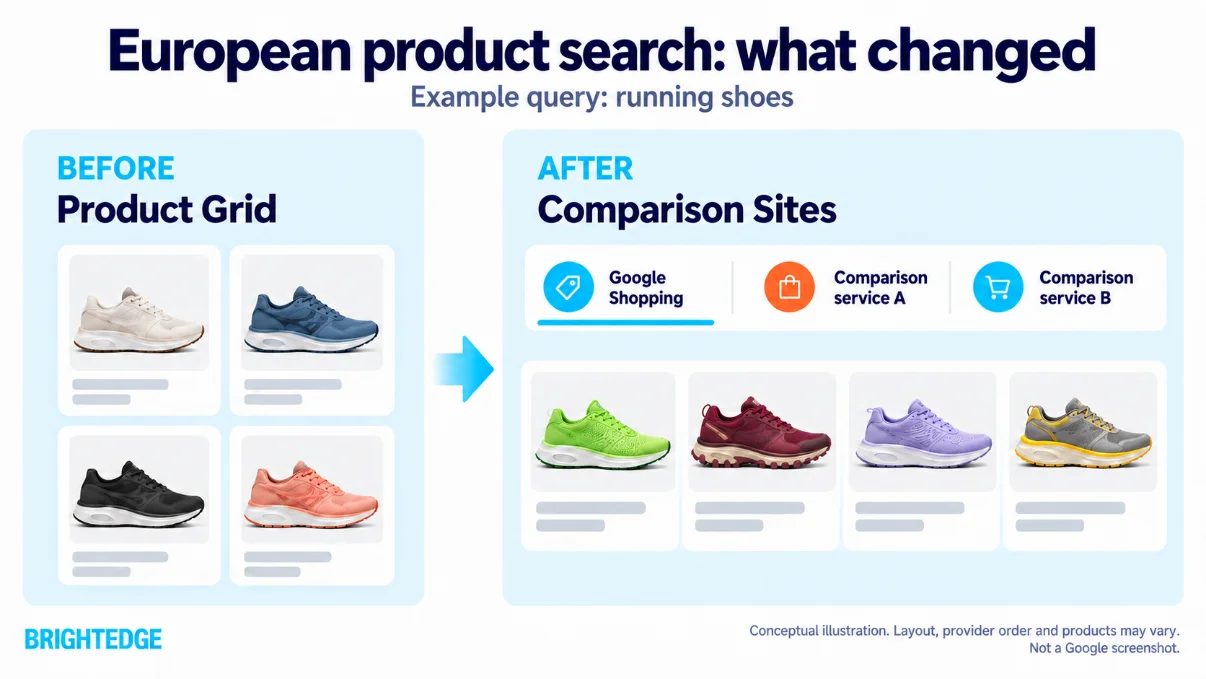
Illustration comparing a product grid with a Comparison Sites section containing Google Shopping and third-party services

Key takeaways

  • One date, every tracked market: Product Grid listings stopped appearing in all 14 EEA markets BrightEdge tracks, and Comparison Sites began appearing in the same 14 markets on the same day, Sept. 16.
  • A dip, then a recovery: The number of keywords showing a comparison section was 38% below the old grid baseline on day one, stayed roughly 12% to 23% below it through Sept. 29, then stepped back above it on Sept. 30.
  • Not every market recovered: Germany, Italy and Spain climbed back above their baselines by Oct. 3, while Finland and Norway were still about 14% and 6% below theirs on Oct. 13.
  • Google Shopping leads the new box: It appears 16 to 35 times as often as the next-largest service, and 71% of Comparison Sites appearances land in the top four result positions.
  • What to do first: Opt into visibility and choose Google as the comparison shopping service (CSS) that places your free listings in Merchant Center given its dominance in results.

Data collected

The figures come from BrightEdge Professional Services analysis of daily search results collection on a tracked product query set, not from AI Catalyst or AI HyperCube. This period covers the two weeks prior to the change for base-lining and the subsequent time period until metrics stabilized.

ItemDetail
Markets14 EEA markets: Austria, Belgium, Czechia, Denmark, Finland, France, Germany, Greece, Italy, Netherlands, Norway, Poland, Spain, Sweden. The UK, US, Canada and Australia serve as non-EEA comparisons
WindowSept. 1 to Oct. 13, 2026, daily
MeasureDistinct keywords per day showing a Product Grid (through Sept. 15) or a Comparison Sites section (from Sept. 16)
BaselineEach market's Product Grid average for Sept. 10 to 14, set to 100
Reading the countsCounts show volume, not whether the same keywords appear before and after
Share and position dataEEA product results analysis for Germany, France, Spain and Italy, Oct. 2026

Why the grid disappeared

Google removed the grid to comply with a July 23, 2026 European Commission ruling under the Digital Markets Act (DMA), which found Google favored its own shopping, hotel, transport and sports results and fined it EUR 460 million for that finding (coverage). A separate EUR 430 million fine over Google Play brought the day's total to EUR 890 million.
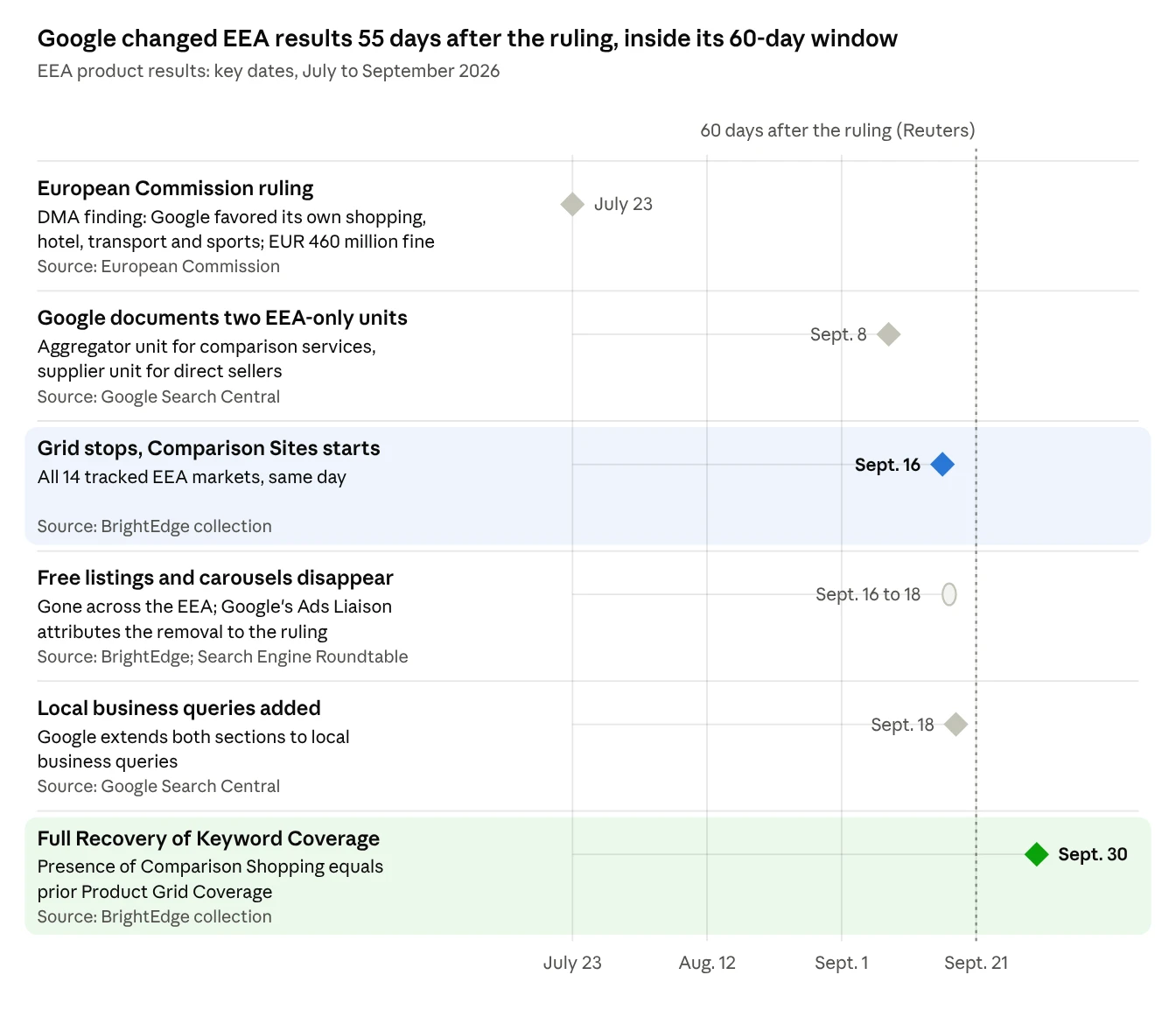
Timeline of EEA product result changes from the July 23, 2026 DMA ruling to the Sept. 16 Comparison Sites switch and the Sept. 30 recovery

Google disagrees with the ruling and told Reuters on Sept. 8 that the changes are the largest reduction in quality of service in its 29-year search history. Reuters reported that Google had 60 days to comply, and the Sept. 16 change landed inside that window. Because this is a compliance step, there is no sign it reverses while the ruling stands.

Product grids vanished on one day, and keyword counts took about two weeks to recover
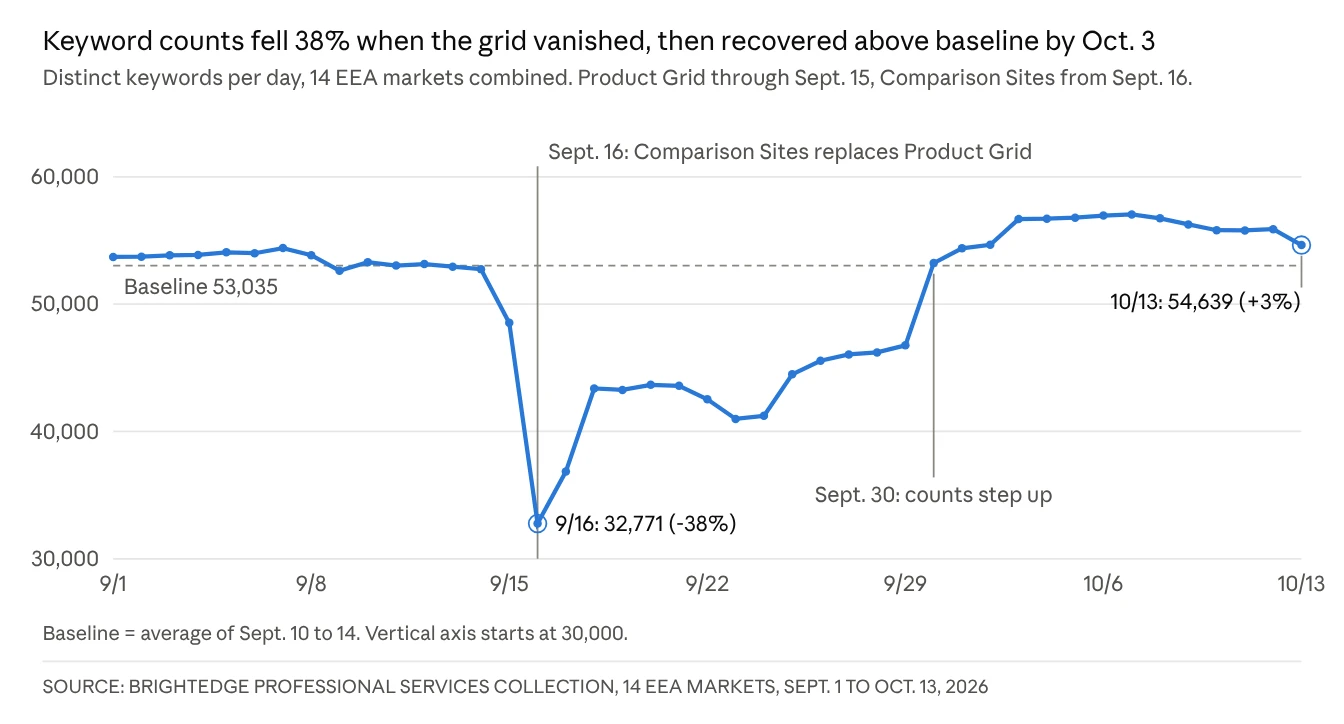
Line chart of distinct keywords per day across 14 EEA markets, dropping 38% on Sept. 16, 2026 and recovering above the 53,035 baseline by Oct. 3

Product Grid listings stopped appearing in all 14 markets after Sept. 15, and the Comparison Sites section began on Sept. 16, the same day everywhere. Day one counted 38% fewer keywords than the old baseline. Counts then sat at roughly 77% to 88% of baseline between Sept. 18 and Sept. 29, and stepped up on Sept. 30. Since Oct. 3 the combined count has held 3% to 8% above baseline. Product Grid stayed flat throughout in the UK, US, Canada and Australia, which sit outside the change.

Read this as a change in volume, not proof that the same keywords moved from one section to the other. The Sept. 30 step also hit the largest markets together, so part of the early dip may reflect the new section being collected and classified in stages.

Large markets rebounded past their old baseline; Finland and Norway never did
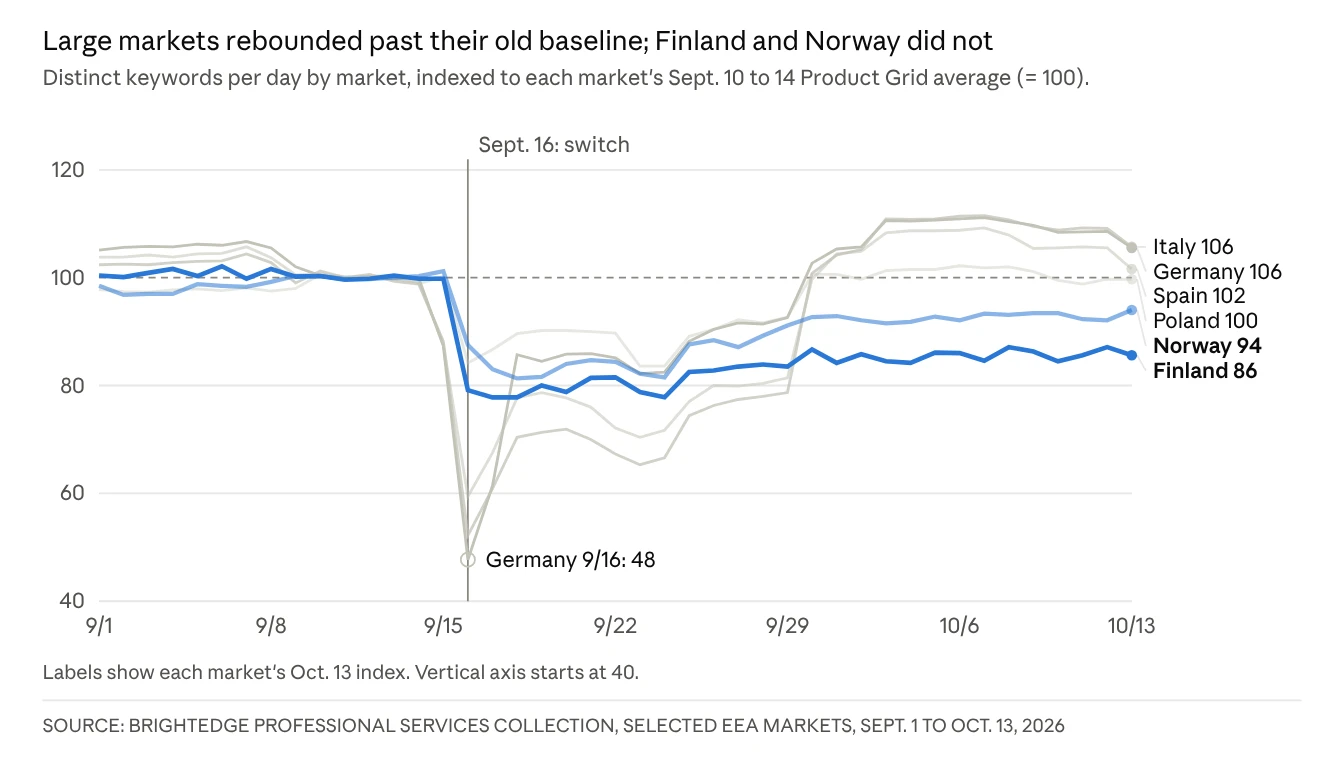
Line chart indexing keyword counts by market: Italy, Germany and Spain rebounded above baseline while Norway (94) and Finland (86) stayed below on Oct. 13

Germany, Italy and Spain took the deepest day-one hits (Germany fell to about half its old count) and recovered slowest, then jumped back above baseline on Sept. 30 and reached about 108% to 111% of it by Oct. 3. Poland dipped less and settled at baseline. Finland and Norway took smaller early hits, missed the Sept. 30 step, and were still about 14% and 6% below baseline on Oct. 13.

Finland and Norway are small markets where a few dozen keywords move the index, so treat them as markets to watch, not proof of lasting loss. The six markets shown are the clearest examples of each pattern; the other eight markets mostly follow the large-market or Poland shape.

Google Shopping leads the new box in every market, for now
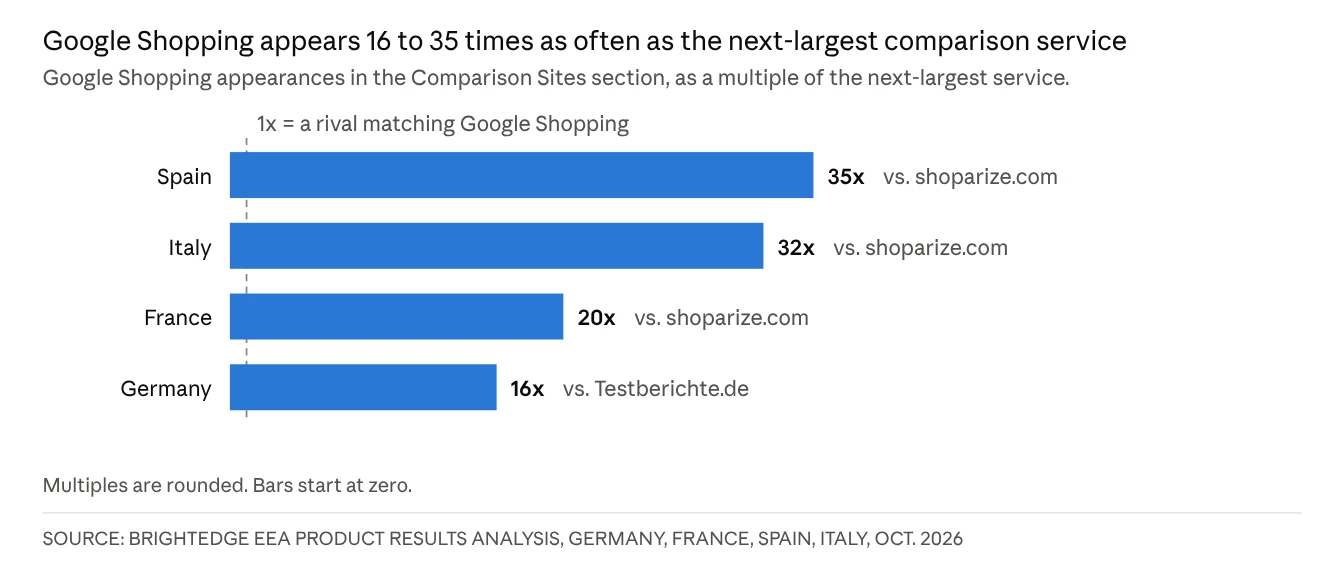
Bar chart showing Google Shopping appears 16 to 35 times as often as the next-largest comparison service in Spain, Italy, France and Germany

Across the four markets analyzed, 71% of Comparison Sites appearances fell in the top four result positions, from 61% in France to 76% in Spain and Italy, so the box is premium space.

The lead is wide today, but the ruling exists to give third-party services comparable prominence. Any service that qualifies or gains share moves visibility toward boxes that Merchant Center does not fill. BrightEdge has no data yet on how fast that happens.

Products still reach EEA searchers by two routes

The change moves where products appear more than whether they can, and it adds a dependency outside Google: part of a merchant's European product visibility now runs through comparison services and the feeds that supply them.

RouteFed byWhat the searcher seesMerchant lever
Google Shopping boxMerchant Center feed, product and offer schema, page contentProduct tiles that open the multi-seller product panel the old grid used, or the Google Shopping pageFeed quality, and selecting Google as the CSS for free listings
Third-party service boxes (idealo, billiger.de, Bigshopper and others)Each service's own catalog, fed by direct feeds, affiliate networks or feed-management partnersA box with one service expanded and others collapsed beneath itPresence and data accuracy in each service's catalog

Google's merchant help says a merchant places free listings through one CSS, chosen in the Merchant Center CSS dashboard, and Google Shopping is one of the options. Because you can only opt for one CSS through the free listings, and with Google outranking other CSSs by more than 16x, we recommend you select Google as your preferred CSS. BrightEdge has not yet tested how a merchant who selects another CSS shows up inside Google's box, and does not recommend a non-Google CSS unless required.

Two business models face extra limits. Google bars a primarily marketplace business from operating as a comparison service, though it can list through one. Comparison-service rules also bar links to merchant sites that sell only to businesses, which narrows the third-party route for a business-only checkout.

Ordinary organic listings keep their role. With the grid gone they have one fewer feature to clear, which puts more of the organic load on product and category pages.

Start here: priority actions

If you do one thing this week, check which CSS your Merchant Center account uses for free listings. It is entirely in your control and it decides which service places those listings. Beyond that, feed hygiene still matters but is no longer the whole job: four actions are urgent, two need evaluation, and one needs monitoring.

PriorityActionWhy
Do nowSelect Google as the CSS for free listings in each Merchant Center account (several CSSs can be selected for paid campaigns, only one for free)Google Shopping holds the leading box in every tracked market
Do nowList the comparison sites and affiliate partners that carry your products in each EEA market, and the feed behind eachThird-party boxes fill from their own catalogs, so presence is decided outside Google
Do nowAlign titles, images, price, availability and GTIN across partner feeds and the Merchant Center feedA product should read the same in every box, and a shared identifier lets each service match the right offer
Do nowRe-baseline EEA product visibility from Sept. 16 and stop comparing it with earlier periodsBefore and after measure different page layouts
EvaluateMap coverage gaps by category and market where no service other than Google Shopping lists your rangeThese gaps lose visibility first if third-party services gain share
EvaluateFor price-comparison or marketplace properties, assess the CSS program and Google's structured data carousel (beta)The comparison side of the section is application-gated
MonitorTrack UK product grid visibility and each service's share of the Comparison Sites section in the EEAA falling Google share is the early signal of a third-party shift

Six best practices for product visibility in the EEA

Google builds a product listing from inputs it reads from your catalog, and retailers directly supply three of them: the product feed, the structured data on the product page, and the web content describing the product. Those same inputs now feed the Google Shopping box, the third-party services that ingest your data, and Google's AI surfaces. Most lost visibility traces to gaps in these inputs, not to a missing strategy, which makes it fixable data work.

InputWhat it doesThe common gap
Merchant Center feedThe structured catalog Google ingests for Shopping, free listings and AI surfacesMissing or invalid attributes, identifiers or disapprovals quietly suppress products
Product pageThe page Google crawls, and the page that has to earn the clickThin or unrenderable pages do not earn ranking, or the click when they do appear
Structured dataConfirms what the product is: price, availability, brand, reviewsWithout valid Product and Offer markup, Google cannot confirm price, availability or reviews

1. Fix the Merchant Center feed first

A product that is disapproved or missing identifiers is not eligible for the surfaces that matter, so start with approval and completeness. Review disapprovals and warnings, identifiers (GTIN, MPN, brand), title, attribute and image quality, and the accuracy of price, availability and shipping information.

Shipping accuracy matters more than most teams expect. In one BrightEdge Professional Services analysis for a national home improvement retailer, a competitor lost visibility every weekend because its 2-day shipping applied only on business days. The client gained traffic after supplying more accurate, up-to-date shipping information in its Merchant Center feed.

2. Choose your comparison shopping service on purpose

In the EEA, a retailer's free listings run through one comparison shopping service (CSS), chosen in the Merchant Center CSS dashboard. Select Google Shopping unless you are required to do otherwise, because it leads the section in every market measured. If the account's CSS is not the one selected, Merchant Center disapproves the products with the message CSS not selected for this destination. Then confirm, market by market, which service carries your free listings, and check that your products appear in the comparison-service results for each market. BrightEdge has not yet tested how a merchant who picks another CSS appears inside Google's box.

3. Make product pages complete and readable by machines

The page has to earn the click, and it has to be readable to the systems that assemble product answers. Serve price, variants, availability and reviews in the page code itself instead of loading them with client-side JavaScript. Most AI agents do not run JavaScript, and Adobe scored US retail product pages 66% machine-readable, the lowest of the page types it measured, and UK product pages averaged the same 66 out of 100.

To check, crawl a sample of product pages without JavaScript and compare what appears with the browser view, and confirm that server logs show AI crawlers fetching the full product content. Where pages are thin, add depth: specifications, sizing, delivery and returns, and trust signals such as reviews. BrightEdge's guide to AI agents covers the access and rendering checks in detail, and BrightEdge AI Agent Insights tracks which agents reach your pages.

4. Add and validate Product and Offer structured data

Structured data confirms what a product is. Use valid Product and Offer markup with price, currency, availability, brand and identifiers, add AggregateRating where you have reviews and BreadcrumbList for context, and cover every product template, not only the top sellers. The markup, the page and the feed should agree, because a mismatch between them undermines the confirmation that structured data exists to provide.

5. Describe every product the same way everywhere

The same product now appears in Google's box, in third-party comparison services fed by their own catalogs, and in AI shopping answers. Compare titles, prices, variants and product numbers across Merchant Center, partner and affiliate feeds, any AI shopping feeds you supply, and the product page. You know it is working when the same details appear in Google and in comparison-service listings for the same product.

6. Measure on a new baseline, and watch availability daily

Results before and after Sept. 16 come from different page layouts, so start EEA product visibility trends again from that date. Track Comparison Sites presence by market and, where you can, each service's share of the section. BrightEdge GSC Reporting is one place to watch clicks on either side of Sept. 16.

Watch the products that carry your visibility. A few products usually drive most of a retailer's product-surface presence, and an out-of-stock or suppressed item can erase it, a drop that Search Console alone can surface weeks late. Report AI-referred visits as their own channel beside organic search, so a shift between channels is visible rather than buried in organic.

EEA product visibility checklist

Feed and CSS

  • Merchant Center disapprovals and warnings reviewed, with no products suppressed by missing or invalid attributes
  • GTIN, MPN and brand present on every product that has them
  • Titles, images, price, availability and shipping information accurate and current
  • Google Shopping selected as the CSS for free listings in each Merchant Center account, or the reason for another choice documented

Product pages and structured data

  • Price, variants, availability and reviews present in the page code, not loaded only by client-side JavaScript
  • A no-JavaScript crawl of sample product pages compared with the browser view
  • Valid Product and Offer markup on every product template, with AggregateRating and BreadcrumbList where they apply
  • Feed, page and markup agree on price and availability

Partners and measurement

  • Comparison sites and affiliate partners that carry your products listed for each EEA market, with the feed behind each
  • Titles, identifiers and variants consistent across partner feeds
  • EEA product visibility trends re-baselined from Sept. 16
  • Daily availability monitoring on the products that carry most of your visibility
  • AI-referred visits reported as their own channel beside organic search

What we do not know yet

The biggest gap for a marketer is the traffic cost. This data measures visibility, not clicks or revenue. Directionally, BrightEdge has seen product page clicks decline and clicks to non-product pages rise alongside this change, but not clearly enough to say the pattern is consistent. Treat it as a lead to test in your own data, not a finding.

Three more questions would change this advice if they resolved differently:

  • Whether the supplier unit, Google's separate section for direct sellers, appears on product queries at all. No capture shows it yet.
  • How Google ranks the services inside the section. Its documentation omits this.
  • Where traffic from the section is reported in Search Console and Merchant Center. Google has not documented it.

How BrightEdge reporting treats the new layout is covered in the FAQ below.

Frequently asked questions

What happened to Google's product grid in Europe?

On Sept. 16, 2026, Google stopped showing its free product grid across the European Economic Area and began showing a Comparison Sites section, where comparison shopping services list products. The change followed a July 23, 2026 European Commission ruling under the Digital Markets Act that fined Google EUR 460 million for favoring its own shopping results.

Which countries are affected?

The EEA, which is the EU plus Iceland, Liechtenstein and Norway. BrightEdge measured the same-day switch in 14 tracked markets. The UK is outside the EEA and kept its product grid.

Is the product grid coming back?

BrightEdge sees no sign that it returns while the ruling stands. Google disagrees with the ruling, but the change is a compliance step.

What is a comparison shopping service (CSS)?

A comparison service that places products in Google results in Europe. A retailer can select only one for its free listings in Europe, and Google Shopping is one of the options. Google's guide to working with comparison shopping services covers the setup.

Should I use a CSS other than Google Shopping?

BrightEdge does not recommend it unless you are required to. Google Shopping appears 16 to 35 times as often as the next-largest service in the markets measured, and BrightEdge has not yet tested how a merchant who picks another CSS appears inside Google's box.

Does feed optimization still matter?

Yes. The feed, the page's structured data and the web content describing the product are the three inputs retailers directly supply behind a Google product card, and third-party comparison services ingest similar product data.

Did my traffic drop?

BrightEdge has directionally seen product page clicks decline and clicks to non-product pages rise alongside this change, but not clearly enough to call the pattern consistent. Check your own data, and compare periods on either side of Sept. 16 with care because they reflect different page layouts.

Where do clicks from the Comparison Sites section show up in reporting?

Google has not documented where these clicks are reported in Search Console and Merchant Center.

Do BrightEdge Product Grid reports still work in the EEA?

From the week of Sept. 27, 2026, platform Product Grid reports reflect the new layout, so grid title, grid rank, product count and seller count can shift for reasons unrelated to SEO performance.

Sources and further reading

From BrightEdge

Google and other sources

×
Request a demo

Request a Personalized Demo

* indicates required


Google's Product Grid Disappeared in 14 European Markets: What Retailers Need to Check

On 16 September 2026 Product Grid listings stopped appearing in all 14 EEA markets BrightEdge tracks, and a Comparison Sites section began appearing in the same markets on the same day.

On 16 September 2026, Product Grid listings stopped appearing in all 14 EEA markets BrightEdge tracks. A Comparison Sites section began appearing in the same markets on the same day. In the EEA a retailer's free product listings run through one comparison shopping service. Google Shopping appeared in the new section 16 to 35 times as often as the next-largest service. That is across Germany, France, Spain and Italy, on tracked queries from 9 to 29 September.

Which service represents your domain is quick to establish. It sits in the Merchant Center CSS dashboard, it costs nothing to check, and it decides which service places your free listings. Feed quality and your relationships with third-party catalogs sit alongside it.

What this measures: This counts how many tracked keywords display each section. It does not show whether a given merchant's products appear inside it, and it does not measure clicks. The markets are the 14 EEA markets BrightEdge tracks, which are 13 EU countries plus Norway. Other EEA markets exist and were not measured.

The switch happened on one day, in every tracked market

Product Grid listings stopped appearing in all 14 tracked EEA markets after 15 September. The Comparison Sites section began on 16 September, the same day in every one of them. Product Grid stayed flat throughout in the UK, US, Canada and Australia, which sit outside the change.

Google removed the grid to comply with a European Commission ruling of 23 July 2026 under the Digital Markets Act. The ruling found that Google favored its own shopping, hotel, transport and sports results, and fined it EUR 460 million. Reuters reported a 60-day compliance window, and the September change landed inside it.

Google disagrees with the ruling. The change is a compliance step. Compliance does not establish that this particular layout has to remain, so treat the current arrangement as the position in the measured window.

One setting decides which service places your free listings

In the EEA, one comparison shopping service represents a merchant domain for free product listings. Google documents this per domain. Several services can be used for paid campaigns, and one carries the free listings. This rule predates the September change. What changed on 16 September is the place those listings appear.

Google Shopping appeared in the Comparison Sites section 16 to 35 times as often as the next-largest service. That is across Germany, France, Spain and Italy, on tracked queries from 9 to 29 September 2026. 71% of Comparison Sites appearances landed in result positions one to four, from 61% in France to 76% in Spain and Italy. It is premium space.

What the multiple counts. The 16 to 35 times comparison measures how often each service appears in the section. It does not measure an individual merchant's product visibility or performance. BrightEdge has not tested what changes when a merchant switches service. Google Shopping led the section across those three weeks. Read your own selection before deciding whether to change it.

Confirm which CSS represents your domain, resolve related disapprovals, and check whether priority products appear.

Where the selection does not match the destination, Merchant Center disapproves the products with the message "CSS not selected for this destination". Resolve the CSS mismatch, then check for any remaining eligibility issues.

Merchant Center and third-party catalogs provide separate routes into the section

RouteFed byYour lever
Google Shopping boxMerchant Center feed, product and offer schema, page contentFeed quality, and which CSS represents your domain for free listings
Third-party service boxesEach service's own catalog, fed by direct feeds, affiliate networks or feed partnersPresence and data accuracy in each service's catalog

Coverage figures cover 1 September to 13 October 2026. Share and position figures cover 9 to 29 September 2026. Routes by which a product can appear in the Comparison Sites section. Source: BrightEdge Professional Services, with CSS mechanics from Google Merchant Center documentation.

Third-party comparison services use their own product catalogs, separate from Merchant Center. Retailers should check which services carry their products and whether the information is accurate.

Google Shopping appeared substantially more often than other services during the period measured. The section exists to give third-party services comparable prominence. Monitor changes in service appearances alongside your own product coverage.

Coverage returned to its previous level by 30 September

On 16 September, the number of tracked keywords showing a Comparison Sites section was 38% below the previous Product Grid baseline. Coverage increased through the remainder of September and matched the previous baseline on 30 September. The baseline is 53,035 keywords, day one counted 32,771, and 30 September counted 53,227.

Since 3 October, the combined count has remained 3% to 8% above that baseline.

These figures measure how often a product section appeared in tracked search results. They do not establish whether individual retailers retained their visibility or traffic. Changes in how the new section was collected may also have affected the early trend.

Markets did not move together

MarketDay oneIndex level, with the date of that reading
GermanyFell to about half its old count108% to 111% of baseline on 3 October
ItalyDeep day-one drop108% to 111% of baseline on 3 October
SpainDeep day-one drop108% to 111% of baseline on 3 October
PolandDipped lessAt baseline on 13 October
FinlandSmaller early hitAbout 14% below baseline on 13 October
NorwaySmaller early hitAbout 6% below baseline on 13 October

Selected markets, indexed to each market's own Product Grid average for 10 to 14 September. Source: BrightEdge Professional Services, 1 September to 13 October 2026. The six shown are the clearest examples of each pattern. The other eight tracked markets mostly follow the large-market or Poland shape.

Germany, Italy and Spain took the deepest day-one hits and recovered slowest, then sat above their old baselines on 3 October. Finland and Norway took smaller early hits and missed the 30 September step.

Finland and Norway remained below baseline on 13 October, the last day of the window. Both are small markets where a few dozen keywords move the index, so neither reading is a reliable guide alone.

What to do before the holiday peak

  • Establish which CSS represents each merchant domain for free listings. Confirm the service, resolve eligibility issues, and assess that choice against your own product visibility. A market-wide share does not answer it.
  • Annotate 16 September in European product reporting. The grid and the Comparison Sites section are different layouts, so measures either side are not like for like. Mark the date, report layout-specific measures separately, and keep the earlier history.
  • Establish which third-party services carry your priority products, market by market. Those boxes fill from each service's own catalog. Record the service, the feed behind it, and whether the product data is accurate. Order the work by which markets carry your peak trading. The recovery index does not tell you where your catalog gaps are.
  • Make the feed, the page and the structured data agree. Product information may appear across Google Shopping, third-party catalogs and AI shopping experiences. Match titles, prices, availability and identifiers across all of them.
  • Compare clicks either side of 16 September. Compare product-page and non-product-page clicks before and after the change.

Start by checking CSS setup and product eligibility. Then prioritize the markets and products that matter most for holiday trading. Building coverage across third-party catalogs is slower, and how far up the list it belongs depends on which markets and products carry your peak.

Related check: product-page accessibility

Product-page accessibility is a related readiness check, and it sits outside the research above.

Crawlers vary in whether and when they execute JavaScript, and several AI crawlers fetch raw HTML without rendering it. Content that appears only after client-side rendering may be missed, so serve price, variants, availability and reviews in the page code itself.

Test this on your own pages. An industry average does not tell you which of your templates fail. Crawl a sample of product pages with JavaScript disabled and compare what appears with the browser view. Then check server logs for which crawlers fetched the full product content.

How to check this for your own site

Before you compare anything, note what changed in the reports. From the week of 27 September 2026, BrightEdge platform Product Grid reports reflect the new layout. Grid title, grid rank, product count and seller count can shift for reasons unrelated to SEO performance.

Find the keywords that lost a grid listing. In BrightEdge Product Grid reporting, pull the EEA keywords where your products appeared in the grid before 16 September, by market. Those are the keywords to follow through the switch.

Compare by market, with 16 September annotated. In Data Cube X and Product Grid reporting, compare keyword counts by listing type for your domain on either side of 16 September. Index each market to its 10 to 14 September average, as this edition does.

Compare clicks across the switch. In GSC Reporting, compare clicks to product pages and to non-product pages for your EEA markets before and after 16 September.

Frequently asked questions

What is the Comparison Sites section?

A section Google began showing on 16 September 2026, observed in the 14 EEA markets BrightEdge tracks, where comparison shopping services list products. Google Shopping, Google's own service, is one of them. It replaced the free product grid.

What is a comparison shopping service?

A service that places products in Google results in Europe, such as Google Shopping, idealo or billiger.de. A retailer selects one for its free listings.

Is the product grid gone everywhere?

No. The 14 EEA markets BrightEdge tracks all switched on 16 September. The UK, US, Canada and Australia kept the grid throughout the window.

Which markets did BrightEdge measure?

Austria, Belgium, Czechia, Denmark, Finland, France, Germany, Greece, Italy, the Netherlands, Norway, Poland, Spain and Sweden. These are 13 EU countries plus Norway. Other EEA markets exist and were not measured, so this edition does not describe them. Share and position figures cover Germany, France, Spain and Italy.

Which comparison shopping service should I select?

This research does not answer that. Google Shopping appeared 16 to 35 times as often as the next-largest service. That is across Germany, France, Spain and Italy, from 9 to 29 September 2026. That figure measures how often each service shows up in the section. It does not measure how a merchant's products perform inside it, and BrightEdge has not tested what changes when a merchant switches service. Start by reading which service represents your domain.

Did EEA traffic drop when the grid was removed?

This edition measures visibility and does not measure clicks, so it cannot answer that. Compare clicks to your product pages and to your non-product pages either side of 16 September in your own reporting.

Are merchants keeping their visibility?

The counts cannot answer that. Keyword coverage of the Comparison Sites section matched the old Product Grid level by 30 September. The counts show how many keywords display the section. Whether a given merchant's products appear inside it is a different question. That depends on your CSS selection and on the feeds third-party services ingest.

Is the grid coming back?

Unknown. The change is a compliance step and Google disagrees with the ruling. Compliance with the decision does not establish that this particular layout has to remain.

Technical methodology

FieldValue
SourceBrightEdge Professional Services Total Search Visibility daily collection on a tracked product query set
Window1 September to 13 October 2026, daily
MarketsThe 14 EEA markets BrightEdge tracks, being 13 EU countries plus Norway. The UK, US, Canada and Australia serve as non-EEA comparisons and Product Grid stayed flat in all four
MetricDistinct keywords per day, per market, showing a Product Grid through 15 September or a Comparison Sites section from 16 September. The combined series sums the 14 markets, so a keyword tracked in more than one market counts once in each
BaselineEach market's Product Grid average for 10 to 14 September is set to 100, and the combined baseline is 53,035 keywords. 10 September is the start because Austria, Belgium and Czechia expanded their tracked sets that day
Transition daysCombined Product Grid keywords fell about 8% on 15 September, before the first Comparison Sites row appeared. This edition dates the switch to 16 September
Share and positionGoogle Shopping's multiple is its appearances in the section divided by the next-largest service's appearances. Tracked queries in Germany, France, Spain and Italy, 9 to 29 September 2026. This is a narrower window than the daily coverage collection, which runs 1 September to 13 October 2026
Known alternative explanationThe 30 September step hit the largest markets together and row counts moved unevenly across markets. A classification change on the collection side has not been ruled out
Not measuredClicks, revenue and AI surfaces. Whether the same keywords appear on both sides of the switch. Whether any individual merchant's products appear in the section. Whether selecting a different comparison shopping service changes a merchant's visibility
ContextThe 23 July 2026 ruling and the 60-day compliance window come from public coverage

Key takeaways

FindingSupporting evidence
One service represents your domain for free listings, and it is yours to read and changeOne CSS carries free listings in the EEA. Google Shopping appeared 16 to 35 times as often as the next-largest service in Germany, France, Spain and Italy, 9 to 29 September 2026
The switch happened on a single day across every tracked marketProduct Grid listings stopped and Comparison Sites began on 16 September 2026 in all 14 tracked EEA markets
The section is premium space71% of Comparison Sites appearances land in positions one to four, from 61% in France to 76% in Spain and Italy
Part of your product visibility runs through third-party catalogsThird-party catalogs are supplied separately from Merchant Center, directly or through partners
Coverage returned to its previous level38% below baseline on 16 September, level with the 53,035 baseline on 30 September

What is still open

Three questions would change this advice if they resolved differently.

  • Whether the supplier unit, Google's separate section for direct sellers, appears on product queries at all. No capture in this collection shows it.
  • How Google ranks the services inside the section. We have not located documentation.
  • Where clicks from the section are reported in Search Console and Merchant Center. We have not located documentation.

More from this series

See the rest of the Weekly AI & Search Insights series. 
For more on the grid removal and the Google Shopping lead, read EEA Product Grid Is Gone: Google Shopping Still Leads.
For the access and rendering checks behind machine-readable product pages, read our guide to AI agents.

BrightEdge tracks product visibility across search and AI surfaces. See how your products appear in the markets that changed with Data Cube X, or request a demo.
 

Download the Full Report

Download PDF

Click the button above to download the full report in PDF format.

Published on October 23, 2026

Subscribe for Weekly Updates

Inside Hershey’s Halloween Marketing Makeover

English, British
News Item Title
Inside Hershey’s Halloween Marketing Makeover
News Item Author Name
Forbes
News Item Published Date
News Item Summary

Hershey is reinventing Halloween marketing by extending seasonal campaigns beyond October through nostalgia, influencer partnerships, social media engagement, and limited-edition products. With a 20% increase in its marketing budget, the company aims to build emotional connections and encourage earlier purchases. The strategy also reflects a broader shift in how consumers discover products. Jim Yu, founder and CEO of BrightEdge, an SEO and AI search optimization company, highlights the importance of adapting to evolving search behaviors as AI reshapes product discovery. For brands like Hershey, combining creative storytelling with strong visibility across traditional search engines and AI platforms can help capture consumer attention throughout the buying journey.

This Is the First Agentic Shopping Season

Jim
Jim
M Posted 1 month ago
t 9 min read

AI agents have started buying on shoppers’ behalf. Here’s what that means for the brands they buy from.

This holiday season, AI agents are buying things on our behalf. The numbers are small, but they are large enough for me to call this the first agentic shopping season.

Our data shows purchases made through AI agents have about quadrupled since April, and they are growing roughly 43% month over month. The growth is fast, from a very small base. I shared those numbers with Asa Fitch at The Wall Street Journal because they mark a line we had not crossed before. Agents have moved from browsing to buying.

Adoption is still early. Only about 3% of the ecommerce brands we work with let agents complete transactions today. I expect the share to rise quickly once shoppers see agents get the order right.

The Traffic Came First

Agents showed up on websites well before they started buying. In April, AI agent requests reached 88% of human organic search visits across the sites we track. Most recently, our September AI Market Pulse found that AI platforms accounted for 2.25% of search referral traffic, up from 1.95% in August. ChatGPT drove 96.3% of those AI referrals.

Most sites are still not ready for agents. Our research found 97% of the top 20,000 websites do not offer agents a lighter format such as Markdown, which agents can process with less effort.

Every Model Shops a Little Differently

Each AI model evaluates a potential purchase in its own way. As I shared with Asa, that makes it more complicated for marketers, but it also makes it very interesting.

We see the difference in our own retail research. Google AI Overviews directed 30% of transactional citations to a major retailer domain, compared with 15% for ChatGPT. The same retailer can show up very differently depending on which AI engine a shopper uses.

Travel tells a similar story. In our latest holiday travel research, Hilton leads hotels in Google AI Overviews, while Marriott leads in ChatGPT. We published the full category rankings on October 21.

The Advantage People Underestimate

Most of the attention goes to ChatGPT, and the AI referral numbers explain why. But look at search overall. Our September AI Market Pulse shows Google still accounts for 86.3% of search referral traffic.

That lead is why I think Google has a big advantage in agentic commerce that people don’t fully appreciate.

To complete even a basic purchase, an agent has to handle payments and taxes. Google already has the wallet and the tax infrastructure. Its Universal Commerce Protocol also builds on the product feeds retailers already send. Payments, tax and product feeds will matter as much as the model itself.

The Real Battle Is Over the Customer

Every retailer I talk to wants to protect the same asset: the customer relationship they spent years building. This season, an agent is starting to stand between that customer and the store. When an AI platform decides which products a shopper sees, the retailer risks losing control of that relationship.

Amazon blocks outside agents. My read is that it wants to protect its direct relationship with every Prime household, and I understand why. For routine purchases, an agent can compare price, availability and delivery across retailers in seconds. Instant comparison puts real pressure on loyalty and could pull the relationship toward the AI platform. Brands need to give shoppers a reason to choose them, even when an agent does the comparing.

Established brands still have an advantage. Years of reputation, recognition and customer trust give them a strong foundation in AI search. That history also has a downside: AI can surface information about a brand from years ago, whether it reflects the company today or not.

What I Would Do Before Black Friday

Start by making your key pages easy for agents to read. When our customers serve agents a lean version of their pages, agents tend to come back more often. Arm, for example, more than doubled verified AI agent traffic to its optimized pages within weeks of turning on BrightEdge Agent Edge. That is one customer’s result, and it shows what happens when agents can reach the right information.

Agents ask practical questions. Is it in stock? Can it ship tomorrow? Do loyalty points apply? Put those answers on the page, and keep product ID, price and availability consistent in your structured data.

Finally, market to people and machines together. Shoppers search, ask AI and send agents to shop for them. Your brand has to appear at each of those points: in search, in AI answers and in front of agents. We’ve added the full readiness checklist in our guide to how AI shopping agents choose brands.

One Platform for Search, AI and Agents

At BrightEdge, we are bringing Google search, AI search visibility and AI agent activity together in one platform. That gives retailers a clearer picture of how shoppers and agents find their products, where visibility gaps exist and what needs attention.

BrightEdge Agent Edge serves verified AI agents a lightweight version of each page, without rebuilding the site or changing the CMS publishing workflow. AI Agent Insights shows which agents visit your site and where they run into errors. AI Catalyst tracks how AI answers mention and cite your brand, right next to your Google performance.

Agent Shopping Will Grow Category by Category

I don’t expect shoppers to hand every decision to AI agents at once. Delegation will vary by category, price point and urgency, and big-ticket purchases will require more thought. Still, agentic shopping is here, and every brand will have to manage it.

Google remains central to product discovery, and AI assistants now give shoppers more ways to compare and choose brands. That means brands need visibility in Google and AI search, and agents need access to accurate product information.

The crown jewel hasn’t changed. The customer is still the prize, and this season an agent may be the one walking through your door. We are tracking agentic commerce every week at brightedge.com/agentic-commerce, and I would love to hear what you are seeing.

Holiday Travel in AI Search: The Travel Brands AI Puts on Its List

Which travel brands lead Google AI Overviews and ChatGPT this holiday season? New BrightEdge research reveals the rankings, the competitive differences and the travel questions where brands appear in AI answers.

Which Travel Brands Lead AI Search This Holiday Season?

Holiday travelers are using AI to explore destinations, compare options and research bookings. For travel brands, visibility increasingly depends on which questions people ask and which AI engine answers them.

BrightEdge analyzed US holiday travel questions across Google AI Overviews and ChatGPT, comparing airlines, hotels, cruise lines and booking platforms against direct competitors.

American Airlines, Royal Caribbean and Expedia lead their categories on both engines. The hotel rankings are closer: Hilton leads on Google AI Overviews, while Marriott leads on ChatGPT.

The full report examines those differences and shows where travel companies appear across inspiration, comparison, booking-intent and budget-related questions.

Key Findings in This Report

  • Hotel leadership changes by engine. Hilton leads Google AI Overviews at 28.3%, while Marriott leads ChatGPT at 29.4%.
  • Expedia has more than twice Kayak’s visibility on Google AI Overviews. Expedia leads booking platforms at 31.3%, compared with Kayak at 14.4%. Its margin is narrower on ChatGPT.
  • Booking platforms appear more frequently in booking-intent questions. They feature in 12% of inspiration prompts, 25% of comparison prompts and 38% of booking-intent prompts in the tracked Google AI Overviews sample.
  • Budget-related questions show a different pattern. Booking platforms appear in 78% of budget-related Google AI Overviews answers, compared with 17% of other answers.

Download the Full Report

Explore the full category rankings, Google AI Overviews and ChatGPT comparisons, holiday travel planning patterns and practical recommendations for travel marketers.

Source: BrightEdge AI Hyper Cube, US English holiday travel prompts, August to September 2026. Category rankings measure volume-weighted visibility among brands in the same category. Intent and budget findings use a separate, prompt-based measure. Results describe observed visibility, not bookings or market share. The two AI engines were measured with different prompt sets.

Further Resources

Holiday Travel AI Search: October 2026 Announcement: Read the BrightEdge press announcement on the brands leading AI-powered holiday travel planning.

Agentic Commerce Research: Explore how AI is changing shopping, discovery and brand visibility.

BrightEdge AI Hyper Cube: See how brands appear across AI search answers and compare competitive visibility.

Win in AI shopping

Agentic Commerce: How AI Is Changing Holiday Shopping

Agentic commerce is shopping in which AI agents research, compare and buy products for consumers.

This holiday season, shoppers are asking AI assistants what to buy, and in Google AI Mode and Gemini, AI agents can complete the purchase with approved retailers.

This hub brings together BrightEdge research, press coverage and webinars on how AI shopping agents find and recommend brands. Retail and ecommerce teams will also find the fixes to make in Google and AI search before Black Friday.

The holiday shopping shift, in numbers

752%

Growth in AI referrals to ecommerce brands, 2025 holiday season

AI referrals are still a small share of traffic, and they are growing fast.

Source: BrightEdge, Nov 18, 2025; cited by Mars

11%

Holiday ChatGPT prompts that cite a page tied to a past year

ChatGPT still cites holiday pages from past years.

Source: BrightEdge AI Hyper Cube, 13,915 prompts, six US retailers, June to August 2026

46%

Growth in US Google searches for ‘AI shopping assistant,’ year over year

More shoppers are searching for AI shopping assistants.

Source: BrightEdge Data Cube X, Oct 2026

Google is still the most important channel. AI answers now shape holiday choices too, so brands need to show up in both.

Marketing leaders have two jobs this holiday season: find where AI changes which brands shoppers consider and protect the Google traffic that drives revenue today.
Both depend on a shared view of visibility, product accuracy and commercial outcomes across SEO, ecommerce and brand teams.

Latest from BrightEdge

Research, coverage and events on agentic commerce

Updated October 2026

The latest research, coverage and events on agentic commerce and AI holiday shopping, updated through the holiday season.

Nothing here yet. New items are added through the holiday season.

What changes when AI agents shop

AI shopping assistants are handling more product research and comparison, and some agents are beginning to complete purchases.

BrightEdge data reported by The Wall Street Journal shows agent-completed purchases have roughly quadrupled since April 2026, growing approximately 43% month over month. Adoption remains early, with about 3% of ecommerce companies in BrightEdge's customer sample enabling agentic transactions.

For retailers, the agent becomes another decision point between the shopper and the brand. Products need to be discoverable, with accurate information AI agents can access and verify.

ShopperAsks an AI assistant what to buy

AI shopping agentAnother decision point between shopper and brand

ResearchCompareComplete purchase

Your brandDiscoverable products with accurate information

~4×agent-completed purchases since April 2026

~43%growth month over month

~3%of ecommerce companies enable agentic transactions

BrightEdge data reported by The Wall Street Journal
BrightEdge research

What the BrightEdge holiday data shows

We analyzed 13,915 holiday prompts on ChatGPT across six major US retailers, June to August 2026. Last year’s announcements and dated press releases still draw holiday citations away from current store hubs. Three findings set the fix list for peak.

13,915holiday prompts
6major US retailers
Jun–Aug2026, ChatGPT

Finding 1

Last year's pages still answer this year's questions

11% of holiday prompts cite a page tied to a past year, and that figure is a floor. We expected shoppers to name the year when they wanted current deals. Nine of the 10 highest-volume prompts that cite a 2025 holiday announcement name no year at all.

Top 10 prompts citing a 2025 holiday announcement

Name no year (9)Name a year (1)

Finding 2

The newsroom outranks the store

At two of the six retailers, dated press releases take 71.7% and 63.1% of Black Friday citations. Their current store hubs take 10.5% and 13.3%.

Finding 3

One permanent hub holds citations together

At one retailer, a permanent Black Friday hub holds 37.6% of its Black Friday citations on its own and 63.0% with its variants.

Share of Black Friday citations, one retailer

Hub on its ownHub variants

Dated press releases take most Black Friday citations

Share of Black Friday ChatGPT citations at two of six US retailers, June to August 2026

BrightEdge research

Dated press releasesCurrent store hub

Source: BrightEdge AI Hyper Cube, holiday prompts across six US retailers. Retailers not named.
Source: BrightEdge AI Hyper Cube, 13,915 ChatGPT holiday prompts, six US retailers, June to August 2026.
Your checklist for peak

What to fix before Black Friday

  1. Update the pages AI already cites

    Older holiday announcements and newsroom posts keep appearing in AI answers. Find the pages AI engines cite, update the outdated details and link each page to this year’s holiday hub. AI Hyper Cube lists the pages each engine cites, and Content Advisor guides each refresh.

    UseBrightEdge AI Hyper CubeBrightEdge Content Advisor

  2. Make product information accessible to AI agents

    AI shopping agents need accurate pricing, availability, shipping and return details. Keep those details consistent across product pages, structured data and merchant feeds. AI Agent Insights shows which agents visit and where they hit errors, and Agent Edge serves verified agents a lightweight version of each page.

    UseBrightEdge AI Agent InsightsBrightEdge Agent Edge

  3. Measure Google and AI search together

    A strong Google ranking does not guarantee a place in AI shopping recommendations. Track rankings alongside AI mentions, citations, agent visits and referral traffic. AI Catalyst tracks AI mentions and citations next to Google performance, so teams measure both in one connected workflow.

    UseBrightEdge AI Catalyst

What is agentic commerce?

Agentic commerce is shopping in which AI agents research, compare and, where supported, purchase products on behalf of consumers.

For example, a shopper might ask an AI assistant to "find a waterproof jacket under $200 that arrives by Friday." The assistant compares products, checks availability and recommends options. An AI shopping agent may also prepare a cart or complete checkout with the shopper's authorization.

In search-led ecommerce, shoppers research and compare products themselves. In agentic commerce, AI agents take on more of that discovery and decision-making.

Compare Search-led ecommerce Agentic commerce
Who searches The shopper The shopper and the agent, both drawing on search
What gets compared Pages the shopper opens Products the agent can read and confirm
Who decides The shopper The agent recommends, the shopper confirms
Where it starts Search engines and retail sites Search engines and retail sites, AI Overviews, ChatGPT and agent tools

See where your brand appears in Google and AI search

BrightEdge measures Google and AI search in one platform. See where you rank, which pages AI engines cite, which holiday prompts mention your brand and which AI agents visit your site.

Frequently Asked Questions

What is agentic commerce?

Agentic commerce is when AI agents research, compare and buy products on a shopper's behalf. The shopper approves each purchase.

What is agentic shopping?

Agentic shopping is the consumer side of agentic commerce. A shopper asks an AI assistant to find or buy something, and the agent does the legwork.

What is agentic checkout?

Agentic checkout lets an AI agent complete a purchase inside the AI experience. The shopper approves the order, and the merchant fulfills it.

Do AI agents complete holiday purchases today?

Yes, in supported shopping experiences. Google offers agentic shopping and checkout features, while ChatGPT supports product discovery and purchasing options for eligible merchants. Depending on the experience, shoppers may complete checkout within the platform or on the retailer's website.

How is an AI shopping agent different from an AI shopping assistant?

An AI shopping assistant helps a shopper decide. An AI shopping agent goes further and takes action, such as building a cart or completing a supported checkout.

How do AI agents decide which products to recommend?

Agents favor products whose details they can read and verify. Fast-loading pages, product facts that match the feed and clear stock and delivery answers all help.

Does SEO still matter for agentic commerce?

Yes. SEO and AEO run as one workflow. Google is still the most important channel, and many AI answers draw on the same signals that drive organic rankings. Google product listings also feed its AI shopping experiences.

What should retailers and brands fix before Black Friday?

Update the pages AI engines already cite, starting with dated newsroom posts. Consolidate each event on one hub URL, put stock, shipping and loyalty answers on product pages and track Google, AI answers and agent visits in one view.

How can brands measure AI shopping visibility?

Brands can track Google rankings, AI citations, brand mentions and AI agent visits alongside referral traffic and conversions. Comparing these metrics helps identify where products are visible across the shopping journey and where improvements are needed.

 
×
Table of Contents
Table of contents

How AI Shopping Agents Choose Brands and How to Earn the Recommendation

Shoppers now ask AI assistants to evaluate options, check availability and recommend what to buy. In Google AI Mode and Gemini, AI agents can complete the purchase with approved retailers, and in ChatGPT, shoppers can buy through retailer apps. As a result, AI assistants shape which products make a shopper's shortlist.

This guide explains how agentic commerce works, what BrightEdge research shows about AI recommendations, how commerce protocols fit in and which steps enterprise teams can take now. For the latest holiday research, webinars and coverage, see our agentic commerce hub.

Key takeaways

  • Google and AI search work together. Google drove 86.3% of search referrals in September 2026, and AI referrals to ecommerce brands grew 752% in the 2025 holiday season.
  • The AI shortlist is shrinking. ChatGPT recommends about 25% fewer brands per answer, and ecommerce answers fell from about six brands to four.
  • Product data earns the recommendation. Protocols such as ACP and UCP handle checkout. Accurate product facts that agents can reach decide which brands make the shortlist.
  • Few retailers are ready yet. About 3% of the ecommerce companies BrightEdge works with let agents complete purchases.

1. What is agentic commerce?

Agentic commerce is the use of AI agents to shop on a consumer's behalf. The agent researches products, compares options and, where the retailer allows it, completes the purchase.

Take a shopper who wants "a waterproof jacket under $200, suitable for winter hiking, that can arrive by Friday." Without AI, that shopper searches Google, opens retailer sites, compares prices and checks delivery dates. An AI shopping assistant runs those searches, filters out jackets that miss a requirement and returns a shortlist. An AI shopping agent then confirms the chosen jacket is in stock and can arrive by Friday, adds it to a cart and places the order once the shopper approves.

 Search-led ecommerceAI shopping assistantAgentic commerce
Product discoveryShopper searchesAI suggests optionsAgent researches for the shopper
ComparisonShopper compares pagesAI summarizes alternativesAgent evaluates options against requirements
PurchaseShopper checks outShopper usually checks outAgent builds the cart or places the order with shopper approval
Shopper's roleDoes every stepMakes the decisionsSets goals, limits and approvals

Assistants recommend. Agents act on the recommendation, within limits the shopper sets.

2. Why AI recommendations now shape brand visibility

Brands now compete for visibility in AI recommendations as well as in Google. A product can rank well in Google and still be missing from an AI recommendation. A retailer can publish accurate product details on its own site while an AI assistant picks up conflicting details from a reseller listing or an outdated review.

Google is still the largest source of search traffic

In September 2026, Google drove 86.3% of all search referrals and AI search accounted for 2.25%, up from 1.95% in August, according to BrightEdge AI Market Pulse. In November 2025, BrightEdge ecommerce data showed AI referrals made up less than 1% of organic ecommerce traffic, and Google drove 87.6% of organic search traffic to ecommerce brand sites. Brands that run Google search and AI search as one connected workflow cover both paths shoppers take to a purchase.

AI is growing fast from a small base

Direct AI referrals to leading ecommerce brands grew 752% year over year in the 2025 holiday season, as BrightEdge reported in November 2025. AI agent traffic is rising too. In April 2026, BrightEdge data showed AI agent requests to websites reached 88% of the volume of human organic search visits. The figure measures request volume. One agent task can send many requests, so request counts run higher than the number of shoppers behind them. BrightEdge projects agent requests will pass human organic search visits by the end of 2026. Analytics platforms such as Google Analytics do not capture this agent activity, so it rarely appears in standard traffic reports.

Agents have started to buy, too. BrightEdge estimates that purchases made through AI agents are growing 43% month over month and have about quadrupled since April 2026. Only about 3% of the ecommerce companies BrightEdge works with let agents complete transactions, according to BrightEdge data reported by The Wall Street Journal. Jim Yu, BrightEdge CEO, explains what agent-led buying means for retailers in This Is the First Agentic Shopping Season.

AI visibility and AI referral traffic measure different stages of the purchase. Visibility shows whether your brand enters the shopper's consideration set. Referral traffic shows how many shoppers click through from an AI answer to the site. A shopper can compare brands in an AI assistant and then buy through Google or the retailer's site.

3. How AI agents decide which brands to recommend

AI shopping recommendations draw on search results, product data, publishers, reviews and marketplaces, and each AI platform weighs the sources differently.

Four areas where brands shape AI recommendations

Brands can influence four of the signals AI engines weigh when they recommend a product:

  1. Product information. Accurate descriptions, specifications, price, availability, delivery and returns.
  2. Site access. Crawlers and retrieval agents can reach product, pricing and policy pages.
  3. Outside sources. Reviews, publishers and retailers describe the product correctly.
  4. Consistency. The same facts appear on the site, in structured data and in product feeds.

AI cites more sources and recommends fewer brands

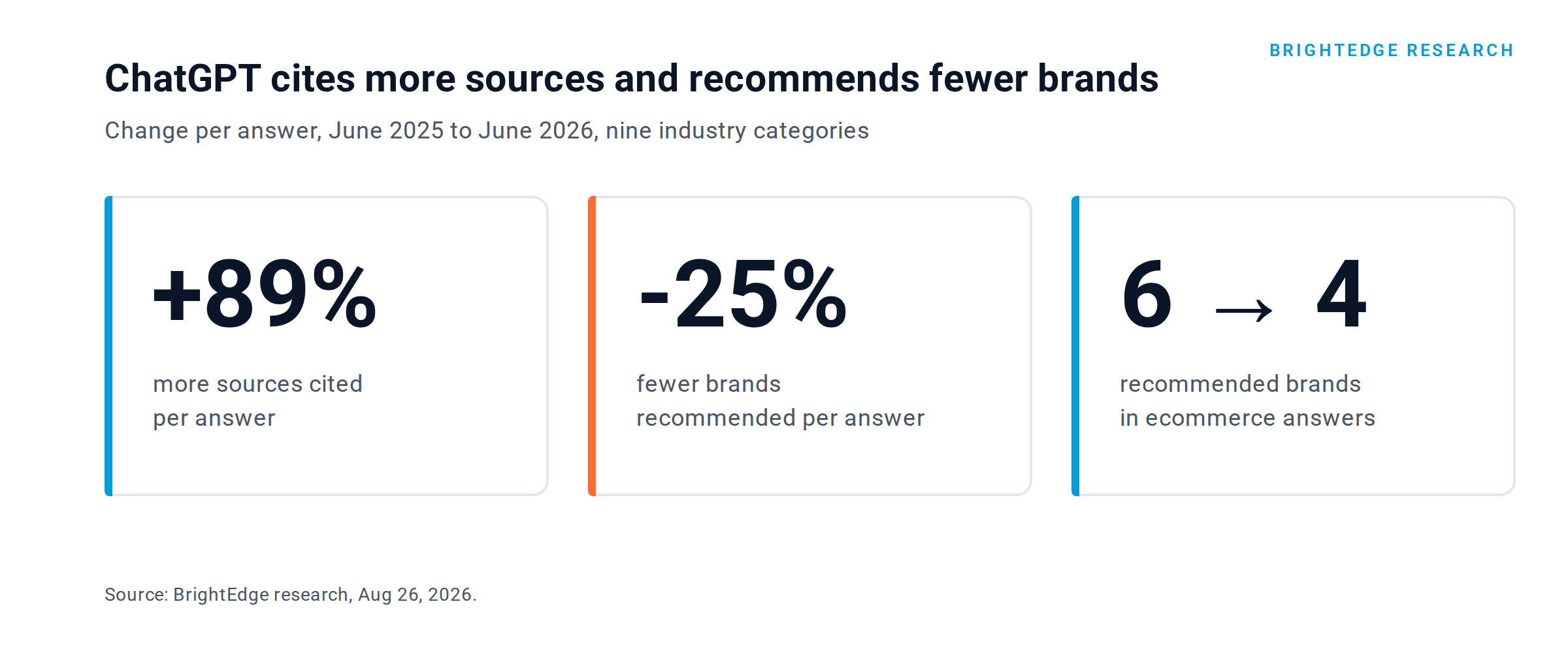
BrightEdge research shows the number of brands in each answer is shrinking. From June 2025 to June 2026, ChatGPT cited about 89% more sources per answer while recommending about 25% fewer brands, across nine industry categories. Ecommerce saw the steepest decline, from roughly six recommended brands to four.

Three stat cards: ChatGPT cited about 89% more sources per answer, recommended about 25% fewer brands, and ecommerce answers fell from about six recommended brands to four between June 2025 and June 2026

ChatGPT cites more sources per answer and names fewer brands, with ecommerce answers falling from about six recommended brands to four. Source: BrightEdge research, Aug 26, 2026.

Google AI Overviews and ChatGPT draw on different sources. A separate, earlier BrightEdge study of retail prompts analyzed that 30% of Google AI Overviews' transactional citations pointed to a major retailer domain, against 15% for ChatGPT. ChatGPT named an average of 7.5 brands per transactional answer, against 6.1 for AI Overviews. The two studies used different prompt sets and time periods, so their brand counts measure different things. Track your category's shopping questions in each engine separately.

Each engine favors different retailer page types. BrightEdge's October 2026 holiday research found that commercial pages accounted for 64.6% of Google AI Overviews' citation weight. Newsroom and help pages accounted for 51.5% of ChatGPT's citation weight. The study covered the top 50 cited results per retailer for holiday prompts at four US retailers from June to August 2026, so the findings apply to those four retailers.

For a travel example, see how travel brand visibility changes with AI search intent.

Jim Yu, BrightEdge CEO, told The Wall Street Journal that each AI model evaluates potential purchases in its own way. "That makes it more complicated for marketers, but that also makes it very interesting," he said.

4. How agentic shopping works, from discovery to checkout

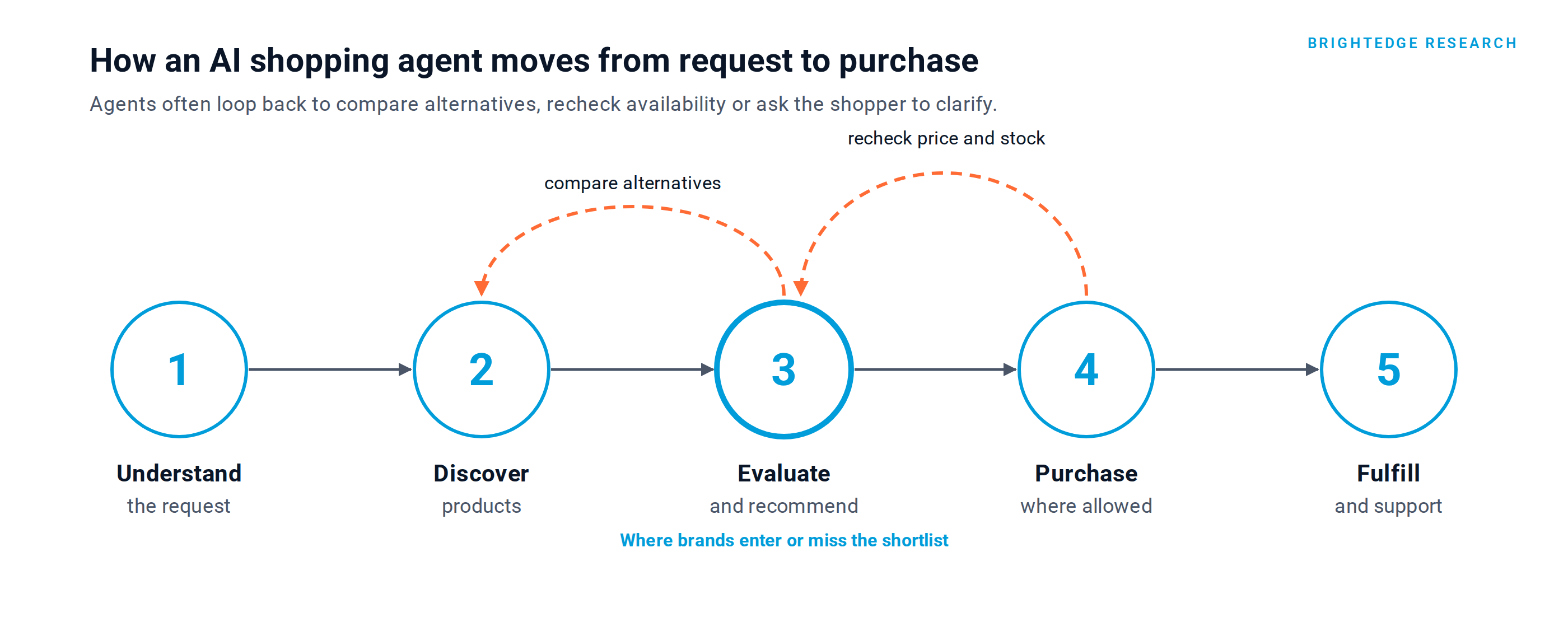
  1. Understand the request. The shopper states a goal. The agent reads budget, category, size, use, brand preferences and delivery needs.
  2. Discover products. The agent finds candidates in search indexes, commerce data and merchant information. A product the agent cannot find at discovery never enters the candidate set.
  3. Evaluate and recommend. The agent checks specifications, price, stock, reviews and retailer policies, then presents a short list. At this step a brand either makes the shopper's shortlist or drops out of it.
  4. Prepare or complete the purchase. The agent sends the shopper to the retailer, builds a cart or starts checkout where the retailer allows it. The available actions depend on the platform, the retailer and the shopper's permissions.
  5. Fulfill and support. The merchant ships the order and handles service and returns.

Agents can loop back at any stage to compare alternatives, recheck availability or ask the shopper to clarify a requirement.

Diagram of the five agentic shopping stages: understand the request, discover products, evaluate and recommend, purchase and fulfill and support. Dashed arrows loop from evaluate back to discover to compare alternatives and from purchase back to evaluate to recheck price and stock

The five stages of agentic shopping. Agents loop back to compare alternatives and recheck price and stock before they buy.

Discovery decides which products enter consideration. Commerce protocols handle checkout and payment. A retailer can be ready for agentic checkout and still be missing from the recommendations shoppers see.

5. Agentic commerce protocols explained: ACP, UCP, AP2 and MCP

Commerce protocols set how AI systems connect to merchants, tools and payments. Each protocol covers a different part of the transaction, from product data to payment.

ProtocolPrimary roleWhy it matters
Agentic Commerce Protocol (ACP)Agent-to-merchant product data and checkout flowsLets agents that use ACP start checkout with the merchant
Universal Commerce Protocol (UCP)Connects Google AI surfaces with merchant commerce systemsEnables purchases in AI Mode and Gemini
Agent Payments Protocol (AP2)Payment authorization for agent purchasesConfirms the shopper authorized the agent's payment
Model Context Protocol (MCP)Connects AI applications to tools and dataLets agents query product, inventory and service systems

Agentic Commerce Protocol (ACP)

Developed by OpenAI and Stripe, ACP supports commerce interactions between AI agents and merchants, including product data and checkout integrations. In March 2026, OpenAI shifted its shopping strategy toward product discovery and merchant-controlled checkout experiences, while retaining options for deeper integrations through ChatGPT apps and approved checkout partners, as Retail TouchPoints reported. For retailers, ACP offers a route into ChatGPT shopping by sharing product data with the experiences that adopt it. Explore the Agentic Commerce Protocol.

Universal Commerce Protocol (UCP)

UCP is an open standard from Google that connects AI shopping experiences with merchant commerce systems. Google uses it to enable agentic actions in AI Mode in Google Search and Gemini, starting with direct buying for approved merchants in the US. Merchants join a waitlist, and Google approves each integration. Retailers considering UCP should review their Merchant Center feeds, checkout capabilities and current participation rules. Read Google's UCP documentation.

Agent Payments Protocol (AP2) and Model Context Protocol (MCP)

AP2 covers payment authorization when an AI agent takes part in a purchase. MCP is a general-purpose protocol that connects AI applications to external tools and data, such as product, inventory or service systems. Neither one decides which products an agent recommends.

Commerce protocols let AI agents and merchants exchange product data and process orders. Recommendations still depend on accurate, accessible product content, so visibility tracking belongs alongside any protocol work.

6. Seven steps to prepare your site for AI shopping agents

Readiness spans SEO, ecommerce, engineering, merchandising and analytics teams.

  1. Check which AI agents reach your site. Review server logs for agents hitting product and category pages. Check robots.txt, firewall rules, CDN rules and rate limits, including 429 (too many requests) errors. Confirm that your rules do not block search and retrieval agents such as OAI-SearchBot and ChatGPT-User. Treat training crawlers, search crawlers and live retrieval agents separately, in line with your content and security policies.
  2. Make key content easy to retrieve. Keep descriptions, specifications and policies in HTML text that agents can read without running scripts. Lightweight versions of key pages, such as Markdown files, give retrieval agents less code to process. A BrightEdge analysis of the top 20,000 websites found that 97% do not serve agents formats such as Markdown, while 61% use schema. These formats are optional for Google visibility. Google states that site owners do not need Markdown or AI-specific files to appear in its generative AI search features.
  3. Keep product facts consistent. Product IDs, specifications, price, availability, shipping and returns should match across product pages, structured data and merchant feeds. For example, an agent may need to confirm that an item can arrive tomorrow, the selected size is in stock, free shipping applies and loyalty points can be used.
  4. Keep pages current. Retire outdated dates, expired promotions and broken links. In BrightEdge's analysis of 13,915 holiday prompts across six major US retailers, 11% of ChatGPT holiday prompts cited a page tied to a past year. Best Buy, which keeps one permanent Black Friday hub URL, held its dated-page share to 4.2%. A permanent seasonal hub, updated each year at the same URL, keeps current offers in one place and gives AI engines one page to cite.
  5. Review commerce integration readiness. Decide whether you need agent-enabled checkout, then check each platform's current requirements for feeds, commerce APIs, authorization and payments.
  6. Check how outside sources describe you. Monitor how AI engines summarize your products and which sources the AI answers rely on. Correct inaccurate specifications and outdated descriptions at the source.
  7. Track recommendations across engines. List the shopping questions in your categories. Track mentions, citations, competitors and sources in Google AI experiences, ChatGPT and other engines over time.

Four measures that show AI shopping impact

Measurement areaQuestion to answerExample metrics
Search visibilityCan shoppers find the brand through Google and other search engines?Keyword rankings, Share of Voice, organic traffic
AI recommendationsDoes the brand appear when AI engines compare products?Mentions, citations, recommendation share, competitor visibility
AI agent activityDo AI agents reach the site successfully?Agent requests, visited URLs, response codes, access errors
Business outcomesDo visibility and agent activity turn into sales?AI referrals, conversions, revenue, attributable agentic transactions

AI referrals undercount AI influence. A shopper can get a recommendation and later return through Google or by typing the brand's URL. Server-side agent requests do not show up as human sessions either. Report measured results, such as referrals and transactions, separately from estimated influence.

Tie every metric to an action:

  • Competitors appear and your brand does not: find the sources and product facts behind the competitor recommendations.
  • Agents request a product page and hit errors: review access rules and page delivery.
  • AI mentions rise without referral growth: check whether the cited pages give shoppers a clear next step, such as a product page with current price and stock.

7. Find and fix AI shopping gaps with BrightEdge

BrightEdge brings Google search performance, AI search visibility and AI agent activity into one connected workflow.

  • Demand and Google visibility. Data Cube X and Share of Voice show search demand and your position in Google.
  • AI recommendations. AI Hyper Cube and AI Catalyst show how AI engines mention, cite and compare your brand against competitors.
  • Agent activity. AI Agent Insights shows which agents visit, what they request and where they hit errors.
  • Agent readiness. Agent Edge detects verified AI agent traffic and serves verified agents a lightweight version of each page.

Sites using Agent Edge have seen agent traffic double or triple within weeks, with AI referral traffic up as much as 30%. Results vary by site. Outside retail, Arm, a semiconductor design company, saw verified AI agent traffic to optimized pages more than double within weeks, and Bloomfire, a B2B knowledge management company, saw a 30% lift in direct AI referral traffic, according to the Agent Edge launch announcement.

With all four views in one place, a team can trace a missing AI recommendation back to a blocked agent, an outdated product fact or a stronger competitor source, then confirm the fix in the same view.

8. Frequently asked questions

What is agentic shopping?

Agentic shopping is the consumer side of agentic commerce: AI that researches and compares products for a shopper and, where the retailer allows it, buys them. How much the agent does depends on the platform, its integrations and the shopper's permissions.

How is agentic commerce different from agentic AI?

Agentic AI covers systems that plan and act toward goals. Agentic commerce applies agentic AI to buying and selling.

Can AI agents complete purchases?

Yes, on some platforms and with approved retailers. Google offers checkout in AI Mode and Gemini for approved merchants, starting in the US, through its Universal Commerce Protocol. In ChatGPT, purchases happen on the retailer's own site or through retailer apps inside ChatGPT. Purchases are subject to the authorization and approval requirements of the platform, merchant and shopping experience. Few merchants have switched agent checkout on yet. BrightEdge data reported by The Wall Street Journal shows about 3% of the ecommerce companies BrightEdge works with let agents complete transactions.

How can retailers see which AI agents visit their site?

Server logs show it. Look for the user-agent names of AI agents, such as OAI-SearchBot and ChatGPT-User, then check the response codes those agents receive on product pages. BrightEdge data shows analytics platforms such as Google Analytics do not record AI agent visits. BrightEdge AI Agent Insights reports the same activity without manual log review.

Does implementing ACP or UCP guarantee AI recommendations?

No. Commerce protocols handle checkout and payment on the platforms that adopt them. They do not decide whether a platform discovers, lists or recommends a merchant's products.

Does SEO still matter for agentic commerce?

Yes. BrightEdge AI Market Pulse shows Google still drives most search referrals. BrightEdge research also shows the major AI engines rely on search indexes when they build answers, such as Bing for ChatGPT and Google's own index for AI Overviews. A strong Google ranking does not guarantee an AI recommendation, so run SEO and AEO as one workflow and track both. Our Ultimate Guide to GEO covers the full workflow.

Do brands need Markdown or llms.txt files?

Not as a rule. Google's guidance for its generative AI search features lists llms.txt files and Markdown among the things site owners do not need. Some sites serve Markdown anyway because it gives retrieval agents less code to process. Start with accurate product data, pages agents can reach and regular monitoring of AI answers.

What should retailers do first?

Start with a baseline. Check whether AI engines recommend your brand for your top category questions and whether AI agents can reach your product pages. Section 6 covers the full checklist.

See where your brand appears across Google and AI search

AI shopping agents choose products they can find, understand and trust enough to recommend. BrightEdge measures each of those stages, alongside the Google performance that still drives most discovery.

Identify gaps in AI recommendations and agent access | Request a demo

×
Request a demo

Request a Personalized Demo

* indicates required


BrightEdge Data Shows AI Is Making Its Holiday Travel List (And Checking it Twice). Marriott, American Airlines, Royal Caribbean and Expedia Are on It.

BrightEdge Data Shows AI Is Making Its Holiday Travel List (And Checking it Twice). Marriott, American Airlines, Royal Caribbean and Expedia Are on It.

American Airlines, Royal Caribbean and Expedia lead their categories across ChatGPT and Google AI Overviews, with competition for the top hotel spot

SAN MATEO, Calif.—October 21, 2026—BrightEdge, the global leader in enterprise SEO and AI search optimization, today released new research identifying the travel brands standing out in AI-powered holiday planning. American Airlines, Royal Caribbean and Expedia lead their respective categories across both ChatGPT and Google AI Overviews, while Marriott and Hilton compete for the top spot among hotels.

The research examines holiday travel queries and answers across Google AI Overviews and ChatGPT, revealing how major brands compare across booking platforms, hotels, airlines and cruises.

“This is the first holiday travel season where AI is tangibly impacting how travelers discover and choose brands,” said Jim Yu, CEO of BrightEdge. “For marketers, visibility is the new competitive battleground. Understanding which brands AI recommends, what drives those recommendations and where competitors are gaining ground will be critical to capturing demand.”

Hotels: Marriott and Hilton are neck and neck for category leader. In ChatGPT, Marriott takes the lead at 29.4%, followed by Hilton at 27.3%. Hilton leads Google AI Overviews at 28.3%, followed by Marriott at 25.3%.

Cruises: Royal Caribbean leads across both platforms, appearing in 24.8% of Google AI Overviews answers. Its lead is even stronger in ChatGPT, where Royal Caribbean appears in 28.8% of answers, compared with Carnival at 22.1% and Viking at 9.7%.

Airlines: American Airlines takes the lead, appearing in 26.6% of Google AI Overviews answers and 25.3% of ChatGPT answers. United follows at 20.5% and 16.2%, respectively, while Delta appears in 13.4% of Google AI Overviews answers and 15.4% of ChatGPT answers.

Booking platforms: Expedia leads holiday travel, appearing in 31.3% of Google AI Overviews answers, more than twice Kayak’s 14.4%, followed by Booking.com at 13.6%. In ChatGPT, Expedia leads at 26.6%, followed by Kayak at 19.4% and Booking.com at 12.9%.

What Sets the Winners Apart

Expedia’s lead demonstrates the advantage of connecting holiday-specific content directly to booking opportunities. Among major booking platforms, Expedia stands out for its dedicated Thanksgiving and Christmas deals pages that combine travel packages, offers and helpful information in one place, making it better positioned to answer holiday travel questions and capture visibility in AI-powered search.

What This Means for Travel Marketers

For travel marketers, AI visibility creates a new competitive benchmark: how often their brands appear alongside direct rivals, and how those rankings differ across AI platforms. Hotels, airlines, cruise lines and booking platforms should track their presence across the specific occasions and needs driving holiday planning, from family destinations and Christmas cruises to affordable flights and New Year’s hotel stays.

Those findings can guide content priorities. Brands should make relevant amenities, seasonal experiences, routes and booking options easy to find and understand. Expedia’s lead underscores the importance of connecting seasonal content, relevant offers and booking options to give AI platforms a more complete picture of what a brand offers. They should also identify the travel publications, guides and tourism websites informing AI answers, giving communications teams a clearer view of where coverage could support discovery.

As AI-powered discovery expands, understanding which brands lead across different AI platforms will become increasingly important for marketers across industries. To learn how BrightEdge helps brands measure and improve their visibility across traditional and AI-powered search, request a demo at BrightEdge.

About BrightEdge

BrightEdge is the global leader in Enterprise SEO and AI-powered content performance. For more than 18 years, BrightEdge has helped thousands of brands and digital marketers, including 57% of the Fortune 500, transform online opportunities into measurable business results. Its industry-first platform integrates the most comprehensive dataset in search, combining insights from traditional SEO, digital media, social, and content with cutting-edge generative AI capabilities, including its deep learning engine DataMind and AI Catalyst platform. Trusted by enterprises, mid-market companies, and leading digital agencies, BrightEdge continues to set the standard for innovation in search and AI, enabling brands to win by becoming an integral part of the digital experience.

CONTACT: press@brightedge.com

Press Release Date
,