Meta AI Crawler Traffic Surged 30-Fold Ahead of the Muse Launch

Meta's AI crawler requests rose 30-fold on one site the day before Muse launched. What marketing and PR teams should know about AI bot tracking.

BrightEdge AI Agent Insights recorded a 30-fold increase in Meta-identified automated requests on one ecommerce client on September 7, 2026, from about 30,000 requests per day to about 1.0 million. Meta announced Muse, its personal AI agent, the following day. For the next 52 days, Meta ranked second among the ten companies tracked on 49 days and first on three.

Muse raises a practical question for marketing and communications teams: when an AI agent visits a brand's website, whom is it acting for, and how would anyone know? Many automated crawlers do not trigger the tracking that conventional web analytics depends on, because they fetch the HTML and never run the JavaScript a tag needs. A change of this size can pass through a brand's reporting without a single dashboard line moving. This edition sets out what the data shows, what it does not show, and how to track AI bot activity on your own site.

What is Meta Muse, and why does it matter for brand visibility?

Muse is Meta's personal AI agent, announced on September 8, 2026. It carries out tasks for a person across connected services, including email, calendar, bookings and purchases, and it launched in the United States.

Muse reaches the web differently from the crawlers in this research. It drives a browser for the user, one page at a time, during a session, which is retrieval at a person's request rather than bulk crawling. Meta documents a separate bot for user-triggered retrieval, meta-externalfetcher. That string does not appear in this dataset, and Meta has not published which string Muse itself sends.

Server logs can help identify which crawlers access your site and what they request. Standard web analytics often misses this activity, because a bulk crawler fetches HTML and never fires a tag, while an agent driving a real browser runs the same scripts a person would. Robots.txt is voluntary either way, and works only on a bot that declares itself honestly.

What the data shows: Meta AI crawler activity around the Muse launch

On September 7, 2026, automated requests identifying themselves as Meta rose from about 30,000 per day to about 1.0 million on one BrightEdge ecommerce client. Meta announced Muse on September 8. Google remained the largest source of AI crawler activity on 49 of the following 52 days, with Meta first on the other three. Request volume has stayed near the new level.

The step occurred between September 6 and 7. The launch followed on September 8. The increase was measured across two Meta bots that crawl, one used for link previews and one used for training and indexing, rather than the bot Meta documents for retrieval at a person's request. BrightEdge therefore does not attribute the traffic to Muse.

Meta's automated activity on this site grew more than 30-fold within one day, in the same week Meta launched a consumer AI agent. Whether or not Muse was involved, the operational response is the same. Brands need to know which Meta bots are reading their content, and they need to set policy for each one separately.

MeasureValue
Requests per day before, September 6about 30,000
Requests per day after, September 7about 1.0 million
Mean requests per day, September 8 to October 291.17 million
Approaching, late October2 million
Days ranked second of ten49 of 52
Days ranked first3 of 52

Table 1. Automated crawler requests identifying themselves as Meta, one BrightEdge ecommerce client. Meta is meta_facebook_external_hit and meta_external_agent, combined. Source: BrightEdge AI Agent Insights, August 2 to October 29, 2026.

One feature of the daily series qualifies the baseline. Around August 9 to 11, five weeks before the step, Meta reached roughly 0.75 million requests per day and fell back to near zero within days. The pre-step figure of about 30,000 therefore describes a typical day, not the whole period.

The ten companies tracked on this site are Meta, Google, Apple, Amazon, OpenAI, Perplexity, Anthropic, Microsoft, ByteDance and Common Crawl. Google's bots were the largest source of AI crawler activity on 49 of the 52 days after the step. The channel a brand already plans around remained the biggest reader of its pages, and a second large reader arrived alongside it within a day.

A hit is one request from a user-agent string that BrightEdge attributes to a named company. It is not a session, a visit or a person, and a site serving heavier pages will record more hits for the same level of interest.

Meta's AI bots: three user-agents, three different jobs

A single company name can cover requests made for very different reasons. Meta is the clearest example.

BotWhat Meta uses it forWhat you are deciding if you block it
facebookexternalhitGenerates the link preview when a URL is shared on a Meta surface. Not used for AI training.The preview card disappears when anyone shares your URL on a Meta surface. This is a social distribution cost, not an AI one.
meta-externalagentCrawls the web to train foundation models and index content.How Meta's models learn to describe you from here on. It does not reach back into what a model already holds.
meta-externalfetcherRetrieves individual links at a person's request. Not present in this dataset.Retrieval at the moment a person asks. Of the three, this has an immediate cost to a live session, and it is the one a personal agent such as Muse would be expected to use.

Table 2. Meta's bot tokens, their documented functions, and what a brand is choosing between. Function column from Meta's crawler documentation, read November 11, 2026. The third column is BrightEdge's reading of the consequence, not Meta's guidance.

A rule written against the company name treats all three identically, and they do not perform the same function. Blocking every Meta crawler also stops the link preview when someone shares your page. Each should be reviewed on its own. robots.txt evaluates each user-agent string separately, so a site can refuse meta-externalagent and still allow facebookexternalhit. Because robots.txt is voluntary and depends on a bot identifying itself accurately, the rule is only as reliable as the declared identity behind it.

That dependence cuts both ways. Requests in this research are grouped by the identity each one declares, which is not an independent check of who sent them or why.

The wider baseline was already substantial. In April 2026, BrightEdge measured automated requests at 88% of human organic search activity, approximately 15% of total website traffic.

How AI bots work: training, search and user agents

AI bots divide into three types, and each calls for a separate decision. The definitions and shares below come from the BrightEdge guide to AI agents and are measured across tracked sites, not the single client above.

TypeWhat it doesLargest botShare
TrainingBuilds and refreshes the knowledge base behind a modelGPTBot51% of training crawls
SearchRetrieves content to power AI answers and citationsOAI-SearchBot49% of AI search crawls
UserActs for one person during an active sessionChatGPT User96% of AI user traffic

Table 3. The three agent types and the largest bot in each. Source: BrightEdge AI Agent Insights research, November 2025 to February 2026.

Training bots shape how a model describes a brand over time. Search bots determine what is quoted in an answer. User bots act for one person in the moment, which is the category Muse falls into. Companies also run bots outside these three types, for link previews and other specialized functions, as with one of the two Meta strings measured here.

Most published policies address only one of the three. BrightEdge found that 19% of sites carry specific directives for ChatGPT-related bots, while the other 81% apply obsolete or conflicting rules designed for traditional crawlers. Among sites with a policy, 77% focus on blocking training bots, 21% address search bots and 38% address user-facing bots.

A brand that blocks or misclassifies a user bot may lose access or visibility in what that bot assembles for a person. The size of that effect is not measured here. Shopping agents are the case most retailers will encounter first, and the agentic commerce hub covers them in more depth.

What Meta's crawler activity means for marketing and PR teams

For digital marketing teams.

Muse and similar agents will evaluate what a site makes available to them. That work overlaps with technical SEO, and it depends on bots being able to reach the page and read it quickly. Policy decisions on training, search and user bots determine whether that happens.

For PR and communications teams.

Training crawlers such as meta-externalagent influence how Meta's models learn to describe an organization, which means newsrooms, executive biographies and press releases are potential source material whether or not anyone is monitoring access. Link preview crawlers affect how earned coverage appears when it is shared on Meta surfaces, so a blanket block carries a distribution cost. The evidence sits in server logs, not in media monitoring or web analytics, so communications teams often have no view of it unless they ask their web or SEO colleagues for it.

How to track AI bots and AI crawler activity on your website

The first three steps require no BrightEdge product and can begin immediately.

1. Pull your server logs, not your analytics.

AI crawler activity frequently does not reach standard analytics. In the raw logs, identify which bots request your pages, which pages they request most, and where they encounter a 404, a blocked resource or a slow response. Group by user-agent string rather than by company, because one company can run several bots that do different jobs. The output is a list of strings and a list of pages, and many of them will be unfamiliar.

2. Decide separately about training, search and user bots.

Define what each of the three should be permitted to do. Training bots build a model's long-run picture of your brand. Search bots retrieve what gets cited. User bots act for someone who is researching or shopping at that moment. A single blanket rule answers all three questions the same way, usually by default and usually in favor of blocking.

3. Check that a bot can reach your answer quickly.

BrightEdge research found that 97% of the top 20,000 websites are not built to give an agent a quick answer. Heavy navigation and scripts slow a bot before it reaches the content. Open your most commercially important page, reduce it to the text a bot would need, and note how far down the page that text begins.

4. Review your rules as the mix changes.

On this client the mix shifted sharply between a Sunday and a Monday. A rule written against one company can describe a situation that is replaced within a day, so the review schedule should follow how fast the mix moves, not the annual policy cycle.

5. Measure before you change anything.

AI Agent Insights reports which AI crawlers and agents access your site and what they engage with. That is the baseline against which every later change is judged, and it cannot be reconstructed after the fact.

There is a case for tracking AI bots in the same place as search performance. AI Hyper Cube shows how AI platforms represent a brand from the outside, and AI Agent Insights shows how agents experience the site from the inside. AI Catalyst keeps Google performance and AI visibility in a single view. Together they place Google rankings, AI citations and bot requests in one report instead of three. A standalone log tool can show that a bot arrived. It cannot show what that did to the channel a brand already plans around.

6. Serve bots a page they can read.

Agent Edge detects verified agent traffic at the CDN and serves those agents a lightweight page, while human visitors and Googlebot receive the original. Bloomfire found that its comparison and category pages were among its most visited, measured a baseline, launched on a limited set of pages and expanded once the numbers held. Agent traffic to optimized pages doubled, and AI referral traffic rose 30% in July 2026 against the prior 90 days. Arm served agents a payload about 90% smaller and held a 2x lift on optimized pages.

Key Takeaways

FindingEvidence
Meta's AI crawler requests went from negligible to second place in one dayAbout 30,000 to about 1.0 million requests per day, September 6 to 7, 2026, one ecommerce client.
The change was sustained, not a spikeMeta ranked second of ten on 49 of 52 days and first on three, averaging 1.17 million requests per day.
The step came a day before the Muse launch, which is not evidence of a causeThe step occurred September 6 to 7, 2026. Meta launched Muse on September 8. The increase was measured across two Meta bots that crawl, not the user-triggered fetcher, so this research cannot test a link to Muse in either direction.
AI bots fall into three categoriesTraining, search and user bots, each with a different largest bot.
Meta runs separate bots for separate jobsLink previews, model training and indexing, and user-triggered retrieval each carry a different cost if blocked.
A change this size can go unseenConventional web analytics generally does not report AI bot traffic at all.

Frequently Asked Questions

What is AI bot tracking?

AI bot tracking is the practice of identifying which AI crawlers and agents request a site's pages, which pages they request and where they encounter problems. It starts in raw server logs, because standard analytics generally does not capture this traffic. AI Agent Insights provides it continuously within BrightEdge.

How do I track AI crawler activity on my website?

Pull raw server logs rather than relying on analytics, and group requests by user-agent string rather than by company, since one company can run several bots with different functions. A one-off log pull shows whether there is a question worth answering. Continuous monitoring is needed to catch changes such as the one in this research.

What is Meta Muse, and does it crawl my website?

Muse is Meta's personal AI agent, announced on September 8, 2026. It acts for a person across connected services and reaches the web by driving a browser during a session. Meta does not publish which user-agent string Muse sends, so Muse traffic cannot be identified in logs from Meta's documentation alone.

Did Muse cause the increase in Meta crawler traffic?

This research cannot establish that it did. The increase came first, on September 7, and Muse launched on September 8. The two strings measured are bots that crawl, not the one Meta documents for retrieval at a person's request.

What is the difference between a training bot, a search bot and a user bot?

Training bots crawl content to build and refresh the knowledge base behind a model. Search bots retrieve content to power AI answers and citations. User bots act for one person during an active session, which is the category a shopping agent falls into. Each justifies a different access decision.

Should I block Meta's AI crawlers?

Each Meta bot warrants its own decision. Blocking meta-externalagent limits how Meta's models learn about a brand. Blocking facebookexternalhit removes the link preview when a page is shared on a Meta surface. Blocking meta-externalfetcher removes the brand from retrieval at the moment a person asks. A blanket rule treats these as one choice.

What does the Muse launch mean for PR and communications teams?

It makes AI bot activity a communications issue as well as a technical one. Training crawlers influence how models describe an organization, link preview crawlers affect how earned coverage is shared, and the evidence of both sits in server logs. Communications teams should ask web and SEO colleagues for a bot activity report and review access rules for newsroom and executive pages.

How much of my website traffic is AI bots?

This research cannot answer that for a specific site. BrightEdge measured agent activity at approximately 15% of total website traffic in April 2026 across its tracked base. On any individual site the figure depends on the catalog, the page weight and which companies have taken an interest, which is why the first step is a log pull.

Does AI bot traffic turn into revenue?

This research does not say. It counts requests that identify themselves as bots. It does not measure what any bot recommended, whether a purchase followed, or what the traffic was worth, and no commercial comparison was run.

What this measures, and what it does not

The research counts automated requests on one BrightEdge ecommerce client across ten tracked companies, August 2 to October 29, 2026. It does not measure whether any person was involved, what any agent recommended, whether a purchase followed, or what the traffic was worth. It is one site's view, not a market measurement and not a read on BrightEdge's customer base. The step occurred on September 7, before the Muse launch on September 8. The two Meta bots involved crawl rather than fetch at a person's request, so the research does not attribute the traffic to Muse or to a shopper. The section on marketing and PR implications is BrightEdge's interpretation, not a measured result.

FieldValue
CapabilityBrightEdge AI Agent Insights
Headline seriesOne BrightEdge ecommerce client, August 2 to October 29, 2026, daily. Not a market measurement and not a read on BrightEdge's customer base.
Companies trackedTen: Meta, Google, Apple, Amazon, OpenAI, Perplexity, Anthropic, Microsoft, ByteDance, Common Crawl.
Meta definitionmeta_facebook_external_hit and meta_external_agent, combined. This data does not resolve which of the two drove the step.
MeasureA hit is one request from a user-agent string attributed to a named company. Requests are grouped by the identity each one declares, which was not independently verified.
ChronologyThe step is dated September 6 to 7, 2026, before the Muse launch on September 8.
Earlier spikeMeta reached roughly 0.75 million hits per day around August 9 to 11 and fell back within days. The pre-step figure of about 30,000 describes a typical day, not the whole period.
Muse factsLaunch date and description from Meta's announcement of September 8, 2026, checked against four independent write-ups on November 13, 2026. Launch market published as the United States, the narrower of two readings in those sources. The marketing and PR implications section is BrightEdge's reading of the consequences, not a finding from this dataset.
Supporting figuresThe 88%, 15%, 19%, 81%, 77%, 21%, 38% and 97% figures and the three agent-type shares are published BrightEdge research measured across tracked sites, not on this client. The agent-type shares cover November 2025 to February 2026. The policy source gives no base for 77%, 21% and 38%, so they are proportions among companies with a policy.
Not measuredWhat any bot recommended. Whether a purchase followed. Revenue. Any site other than the one client. Whether requests came from Muse specifically rather than another Meta process sharing the same strings.

Source: BrightEdge AI Agent Insights, one ecommerce client, August 2 to October 29, 2026. Ten tracked companies. Muse facts from Meta. Part of the Weekly AI & Search Insights series, following last week's edition on branded AI Overviews.

Download the Full Report

Download PDF

Click the button above to download the full report in PDF format.

Published on November 15, 2026

Subscribe for Weekly Updates

BrightEdge x NAPA Online

How NAPA Online Made Its Product Catalog AI-Ready and Saw a 250% Peak Increase in Agent Visits

Download the Case Study

AI Is Defining Your Brand Before You Get the Chance To

AI Overviews appeared on 64% of the brand searches BrightEdge tracked. Here is how to find out what they say about you, and who is writing it.

When someone searches your brand name, Google increasingly has something to say about you on the results page before they decide where to click. Between 16 August and 24 October 2026, the share of 282 tracked brand and product names showing a Google AI Overview rose from 19% to 64%, a 3.4-fold rise in ten weeks. Over the same weeks, the count of keywords showing an overview across the full tracked keyword list grew 47%. Brand names moved far faster than the list they sit inside.

That matters because an AI Overview is not your messaging. It is a summary assembled from sources, and your own website is only one of the places it can draw from. An overview may describe what your brand does, compare it with alternatives or draw on third-party assessments, and for a growing share of brand searches that description now sits on the results page next to your own listing.

What this measures, and what it does not. Whether a Google AI Overview appears on the results page for a brand name, tracked weekly in BrightEdge keyword reporting across 282 brand and product names, Google United States desktop. It shows that the overview is there. It does not measure whether the brand's own site is cited inside the overview, it does not show what the overview says, and it does not measure clicks, traffic or revenue. Those are the questions the audit below is built to answer.

AI Overviews reached 64% of the tracked brand names

The climb was steady for eight weeks, spiked, and settled lower. In the opening week, 19% of the 282 brand names had an overview. By the closing week, 64% did.

WeekBrand names with an AI OverviewShare of 282
2026345319%
2026368831%
20263814050%
20264016257%
20264220874%
20264318064%

Table 1. Brand names with a Google AI Overview, selected weeks. Source: BrightEdge Keyword Reporting, Google United States desktop, weeks 202634 to 202643.

Do not read 64% as settled. The count hit 208 in one week and fell back to 180 the next, and individual brand names dropped out and returned. BrightEdge found the same shape in ecommerce in 2025, when AI Overview coverage spiked and then pulled back within weeks. The direction is clear. The exact level will keep moving, so treat any single week as provisional rather than a position.

Indexed to the opening week, brand names reached 340 by the closing week against 147 for the full tracked keyword list. Those two series measure different things. The branded figure is the share of a fixed set of 282 terms. The comparison figure is the count of keywords showing an overview across a list whose size is not disclosed and whose composition may have changed. The comparison is useful for direction and scale, not as a like-for-like coverage rate.

Big brands are not exempt

Smaller brand names got overviews first. In the opening week, none of the brand names above 1 million monthly searches had one. Ten weeks later, 56% did, and the gap between the largest and smallest brands had closed from 27 points to 10.

Monthly searches for the brand nameBrand namesWeek 202634Week 202643
Leader brands, 1M+320 of 32 (0%)18 of 32 (56%)
Large brands, 250k to 1M413 of 41 (7%)23 of 41 (56%)
Medium brands, 100k to 250k579 of 57 (16%)38 of 57 (67%)
Small brands, under 100k15241 of 152 (27%)101 of 152 (66%)

Table 2. Brand names with an AI Overview, by search volume. Tiers use the search volume in the keyword export. Source: BrightEdge Keyword Reporting, Google United States desktop.

Weighted by search volume, the effect is larger than the term count suggests. The 50 highest-volume brand names carrying an overview covered about 5.9 million monthly searches in the opening week and about 64.8 million by the closing week, roughly 11 times more, because the biggest brands arrived last. One term, Google Classroom, accounts for 17.5 million of that total, so read the weighted figure as an order of magnitude rather than a precise multiple.

A tiered rollout by search volume would fit this shape. So would several other explanations, and this analysis establishes neither. No public announcement of a branded-query change was found, and the data shows the sequence without showing a cause.

Which brands are still outside, and why that is not a safe place to be

Among the 130 tracked brand names above 100,000 monthly searches, the number with an overview went from 12 to 79. Devices were fully covered by the closing week. Restaurants were almost untouched.

Category, names above 100k searchesNamesWeek 202634Week 202643
Devices and hardware20520
Packaged food and beverage21218
Games and entertainment17215
Finance and payments23113
Software and platforms21111
Restaurants2412
Retail and apparel400

Table 3. Brand names above 100k monthly searches with an AI Overview, by category. Source: BrightEdge Keyword Reporting, Google United States desktop.

Local brands are the most protected group here. Of the 59 tracked brand names whose results also show a local 3-pack, 20% have an overview, against 75% of the other 223. Forty of those 59 are restaurants. Chili's, Outback Steakhouse, Texas Roadhouse and Longhorn Steakhouse have not shown an overview in any week checked. Across all 67 restaurant terms in the set, coverage went from 4 to 12, and excluding those 67 terms the closing figure for the rest of the set is 78%. This describes the 67 restaurant brand names on this list, not restaurant search generally. The local-pack flags were recorded in week 202640 and were not refreshed, so that split is read against an older flag.

The exact words matter. "American Express" carries an overview and "amex" does not. The same brand can be defined for one version of its name and left alone for another, which means checking one term and assuming the rest is not an audit. Separately, several large brands had none in the closing week: PayPal, Charles Schwab, GitHub, Microsoft Teams and New Balance.

Being outside is not the same as being safe. Intent decides a lot here. Definitional terms such as "what is" and "define" were already at 97% of 286 tracked terms in the opening week and were not pulled again, so that figure is an opening-week reading rather than a closing comparison. Terms containing "stock" are now at 84% and terms containing "near me" at 13%, against 64% for brand names. The same intent pattern appears in BrightEdge's earlier work on which queries get AI Overviews. The brand names left out today are the ones whose searches look most like local or transactional intent, and that line has moved before.

What the overview says comes from somewhere

The overview on your brand name is built from sources, and in BrightEdge research the mix is often not what brands expect. Across five AI engines, the engines cite meaningfully different parts of the web while still recommending many of the same brands, which is the finding in why AI engines cite different sources but recommend the same brands.

Social and professional platforms are part of that source mix, and they work differently depending on the engine. BrightEdge's analysis of how ChatGPT and Google AI Overviews cite Facebook, Instagram, LinkedIn, Reddit and YouTube found the two treat them differently, in Profiles over posts. The same split shows up in the detail of how the two engines use Reddit differently and how they cite YouTube differently. Those engines are named here as context for where brand descriptions are assembled. This research measured Google AI Overviews only.

If AI Overviews are new ground, start with what AI Overviews are and how they are built, then the guide to generative engine optimization for how engines choose which brands to describe.

What to do: find out who is defining your brand

You cannot manage a description you have not read. The audit below takes a few hours the first time. It tells you whether AI is describing your brand accurately, who it is relying on to do it, and where to act.

1. Pull every version of your brand name and see which ones trigger an overview.

List the full name, abbreviations, nicknames, product and service names, common misspellings and the names of your top two or three products. Customers use all of them. Check each one in your keyword reporting for whether an AI Overview appears. As the "American Express" and "amex" example shows, one version of a brand name can trigger an AI Overview while another does not. Report these as their own segment rather than inside a site-wide keyword number: brand names rose 3.4 times here while the full tracked set grew 47%, and a blended number can obscure that difference.

2. Read the overview as a customer would, and write down what it says.

Capture the description: what it says you are, who you serve, what you cost, where you operate and when you were founded. Flag anything wrong, outdated or missing, and anything you would not say yourself. Note which competitors or alternatives it names next to you. This is the step the presence figure cannot do for you, because presence and content are two different measurements.

3. List the sources it cites and sort them into yours and not yours.

For each cited source, record the type: your own site, a review or comparison site, news, a community such as Reddit, LinkedIn, YouTube, a partner or a competitor. Sources outside your website can influence how AI describes your brand. Identifying them helps show where your brand narrative is being shaped, and where to spend effort.

4. Go beyond keywords and check the prompts people ask AI about you.

A brand name search is one entry point. People also ask conversational questions, and each one is a chance for someone else to define you. Run a set like this:

Prompt typeExample patternWhat you learn
DefinitionWhat is [brand]?How AI categorizes you
ReputationIs [brand] legit? Is [brand] any good?Sentiment and risks AI repeats
Comparison[brand] vs [competitor]Who AI places you beside
Alternatives[brand] alternatives; best [your category]Whether you make the shortlist
Fit[brand] for [use case or audience]Which uses AI assigns you
Facts[brand] pricing, headquarters, founderWhether the basics are accurate
Local, if relevant[brand] near me; [brand] hoursWhether the local pack or the overview leads

Table 4. A starting prompt set for a brand description audit.

For each prompt, record whether you are mentioned, in what position, with what sentiment, and which sources are cited. Doing this by hand does not scale past a few dozen prompts, which is the job BrightEdge AI Catalyst is built for: tracking brand mentions, sentiment, citations and competitors across engines over time.

5. Fix what you find at the source, not in the overview.

Wrong or stale facts belong on the pages you control first, then on the third-party pages that carry them. Missing answers need clear, direct pages for the questions the prompts exposed: what you do, who it is for, pricing, how you compare. For social and professional profiles, align your company description, LinkedIn presence, YouTube and community participation with how you want to be described. The on-demand webinar How to Build and Execute a Social Media Strategy for AEO covers how AI engines cite LinkedIn, YouTube, Reddit, Instagram and Facebook, how to align corporate descriptions, job listings and profile structures so engines can verify your business, and how to measure whether offsite work is improving AI visibility. Where a review site, publication or community drives the description, that is where earned coverage and relationships matter, and BrightEdge brand visibility research covers how engines choose which brands to mention.

6. Baseline now, then repeat weekly.

Capture your branded clicks and impressions today. This analysis measures presence, not clicks, and the before-and-after comparison cannot be rebuilt later. Then re-run the audit weekly for a month before acting on any one reading. One week moved by 28 terms in this data.

Why This Figure Is Lower Than Some Others

Branded AI Overview coverage has been measured publicly by several organizations this autumn, and the figures reported range higher than the 64% here.

The differences are methodological rather than contradictory. Three things move the number.

The keyword list. This set is 282 unmodified brand and product names chosen by analyst judgment, and it is deliberately broad: 67 of them are restaurant brands and 59 return a local 3-pack, the two groups with the least coverage in this data. Excluding the restaurant terms takes the closing figure to 78%.

The definition of branded. A list that includes brand plus modifier terms, such as a brand name with "login" or "stock", measures something broader than the bare brand name. Those are different measurement populations, and this analysis tracks only the bare brand name.

The cadence. A weekly series shows a climb that began in mid-August. A reading taken on two dates shows a step.

None of that makes one figure right and another wrong. It means a branded AI Overview percentage is only comparable against another one when the list, the definition and the dates are stated. Those are stated in full below.

Key Takeaways

FindingEvidence
AI Overviews appeared on 64% of the brand searches BrightEdge tracked19% to 64% of 282 brand names in ten weeks, weeks 202634 to 202643
Brand names moved faster than the list they sit insideA 3.4-fold rise in branded presence against 47% growth in the count of keywords showing an overview across all tracked keywords
Big brands lost their head startNames above 1M searches went from 0% to 56%; weighted by search volume, covered search demand rose about 11 times
The version of the name changes the result"American Express" carries an overview and "amex" does not, so one term is not an audit of a brand
Local and restaurant brands are the exception, for now20% of brand names that also show a local 3-pack carry an overview, against 75% of the rest
The description comes from sources you may not controlBrightEdge research shows AI engines draw on editorial, community and social sources as well as brand sites
One week is not a positionThe count moved from 179 to 208 and back to 180 in three weeks

Frequently Asked Questions

How often do brand name searches trigger a Google AI Overview?

In this sample, 64% did by the closing week, up from 19% ten weeks earlier. The sample is 282 brand and product names tracked weekly on Google United States desktop. Coverage varies by category and by search volume, and restaurant brands are largely an exception.

Does an AI Overview on my brand name hurt my traffic?

This analysis does not say. It measures whether an overview appears, not clicks or traffic, and no Search Console comparison was run. That is why the audit starts with a baseline of branded clicks and impressions.

How do I find out what AI says about my brand?

Search every version of your brand name and read the overviews, note the sources they cite, then test the conversational prompts customers use. A capability such as BrightEdge AI Catalyst tracks mentions, sentiment and citations at scale.

Which brands still do not trigger an AI Overview?

In the closing week, PayPal, Charles Schwab, GitHub, Microsoft Teams and New Balance had none, and restaurant chains including Chili's, Outback Steakhouse, Texas Roadhouse and Longhorn Steakhouse had none in any week checked. Brand names that also show a local 3-pack carry an overview 20% of the time.

Do social platforms and LinkedIn affect how my brand is described?

They can. BrightEdge research shows AI engines cite LinkedIn, YouTube, Reddit and other platforms, and that engines treat them differently. The on-demand webinar on a social media strategy for AEO covers this in detail.

Did AI Overviews reach big brands or small brands first?

Small brands first, in this set. In week 202634 no tracked term above 1M monthly searches carried an overview, while 27% of terms under 100k did. By week 202643 the largest tier had reached 56% and the long tail 66%, closing the gap from 27 points to 10.

About This Data

FieldValue
CapabilityBrightEdge Keyword Reporting, top-page listing, blended rank, BrightEdge search volume
EngineGoogle AI Overviews only. Other engines are not described by this edition
Market and deviceUnited States desktop only. Mobile was not checked, and local packs are usually more prominent on mobile
WindowBrightEdge weeks 202634 to 202643, weekly cadence, 16 August to 24 October 2026. BrightEdge weeks run Sunday to Saturday
Brand set282 unmodified brand and product names selected by analyst judgment from one tracked keyword list. Composition: software 70, restaurants 67, packaged food 36, finance 33, games 29, devices 27, retail 20. Ambiguous names and login or .com variants were excluded
Set caveatA different list gives different shares, and this list is skewed toward topics tracked for AI Overviews
MeasureWhether an AI Overview appears on the results page for the keyword. It does not measure whether the brand's own site is cited inside the overview
Comparison seriesAll tracked keywords with an AI Overview, published as a growth rate and an index. The underlying counts are not disclosed
Volume-weighted figureThe 50 highest-volume brand names carrying an overview, by BrightEdge search volume. The closing side comes from the same 180-term pull that supplies the tier and category counts. One term, Google Classroom, is 17.5 million of the 64.8 million total
Definitional segmentTerms containing "what is" or "define", 286 terms at 97% in week 202634. Not pulled again, so it is reported as an opening-week figure only
Known artifactThe all-keywords series dips in week 202637 while the branded series does not, which points to a collection issue in the totals rather than a real drop. No conclusion is drawn from it
Excluded weekA further week, 202644, returned counts identical to 202643 in both series, 180 branded terms and the same all-keywords total. Two independent weeks matching to the unit in two separate series is more likely to be one collection counted twice, so 202644 is excluded from this analysis pending verification. The closing figure is unaffected either way, because 202643 and 202644 both report the same 180 terms
Local 3-pack flagsRecorded in week 202640 and not refreshed. The local split is read against that older flag
Modified brand setA separate 190-keyword set of brand names plus a modifier was last pulled in week 202640 at 65% and was not refreshed for this update, so it is not compared against the closing branded figure
Supporting fileThe 282-term list is published with this edition. Weekly AI Overview flags in it cover the finance and restaurant categories, 100 terms; the remaining rows are not pulled. The headline counts come from the keyword-level SERP feature report matched to the 282-term list
Not measuredClicks, sessions, traffic, revenue. Whether a brand's own site is cited in the overview. What an overview says. Why coverage arrived in the order it did. Any engine other than Google AI Overviews. Any market outside the United States
ComparabilityBranded AI Overview percentages published elsewhere use different keyword lists, different definitions of a branded query and different collection dates. They are not like-for-like with this figure

Source: BrightEdge Keyword Reporting. Share of 282 tracked unmodified brand names showing a Google AI Overviews result, United States desktop, weeks 202634 to 202643. Part of the Weekly AI & Search Insights series.

Download the Full Report

Download PDF

Click the button above to download the full report in PDF format.

Published on November 06, 2026

Subscribe for Weekly Updates

AI Powered Content Creation

Publish Content That Wins in Search Results and AI Answers

Deciding what to write, and knowing it will work, shouldn't take up your whole day. Content Advisor gives you a clear plan, a ready-to-use brief, and a way to check any draft before it goes live, so everything you publish has a real shot at showing up in search results and AI answers.

app.brightedge.com/content-advisor/
1Enter a topic
2Copilot builds the brief & draft
3Draft written and scored
Content Advisor
Identify strategies to write search-optimized content
CREATE CONTENT OPTIMIZE DRAFT ENHANCE PAGE
Tailored content is a click away
Copilot for Content Advisor uses Generative AI to create search-optimized briefs and drafts.
What's your content topic?
United States CREATE CONTENT
Suggested topics
gen aiYour competitor is ranking for it and has achieved good reach
Insurance AIYour competitors are ranking for it · monthly demand of 1,000
Predictive AIYou track this keyword but don't rank for it yet
Content topicsCreated onCreated byStatus
What is AI overviews4:32 PMjohn.doe@gmail.comVIEW →
AI powered SEO tools3:26 PMchristian@gmail.comVIEW →
Copilot AI in Action
Crafting tailored content for b2b content marketing
Please allow up to 4 minutes as our advanced AI performs a suite of complex tasks.
← BACK TO CONTENT TOPICS
Analyzing Latest TrendsHarnessing recent search data for cutting-edge insights.
Precision Search AnalysisMachine learning algorithms assimilating search data.
Insight DiscoveryExtracting related search terms to expand content relevance.
Question IdentificationFinding frequent audience queries for targeted content.
Comprehensive Page EvaluationAI-driven semantic analysis learning from top pages.
Smart SynthesisAI models interpreting data for authoritative content.
Word Count OptimizationAI calibrating content length for best SEO performance.
Custom Outline CreationCrafting structured outlines tailored to your brief.
Creative SuggestionsAI-driven tools generating unique page titles and meta descriptions.
BRIEFDRAFTPREVIEW & DOWNLOAD
DOWNLOAD
REFINE COPY TO CLIPBOARD Saving… VERSION HISTORY →

B2B Content Marketing: Strategy, Tactics, and Measurement

B2B content marketing turns expertise into growth. It aligns what buyers search for with the proof they need to take the next step. When your team builds a clear b2b content strategy, every asset works harder: you attract qualified demand, enable complex buying groups, and connect activity to pipeline and revenue.

What Is B2B Content Marketing?

B2B content marketing is the practice of planning, creating, and distributing useful, credible content that helps professional buyers progress from problem awareness to purchase and expansion. Buying committees are larger. Sales cycles are longer. Your content must combine authority with practicality.

Stakeholders look for different signals. Executives want outcomes, risk reduction, and a strategic path. Technical evaluators care about integration, security, and implementation. A strong b2b content marketing strategy speaks to each role with evidence, not hype.

Why B2B Content Marketing Matters

Buyers complete most of their research before they ever talk to sales, and much of it now starts with an AI answer. Content that is cited in search results and AI Overviews puts your expertise in front of the committee early, when preferences are still forming.

Content Score
Scoring…
Word count01600-2400
Keywords–
Issues–
Scoring CriteriaTop ranking and AI cited pages
Related search terms4/4 words
Words to avoidNot specified
Reference URLsMatched
Page titleToo long
Related search terms
Pick up to three terms to help your audience find this piece
Influences draft
Search term Volume Keyword Difficulty
brand awareness Primary 590 Hard
measuring brand awareness 260 Possible
brand awareness campaign 590 Hard
brand recognition 1,900 Hard
unaided awareness 170 Easy
awareness marketing 210 Very hard
✦ 2,160 monthly searches unclaimed
Content Planning

Know What to Write Before Your Competitors Do

Most content plans start with a guess, and a deadline. Content Advisor taps into BrightEdge Data Cube X, the largest and most comprehensive research database, to show you which topics people are searching for, and who's already winning them, so every piece you plan starts backed by evidence instead of instinct.

Top ranking and AI cited pages
Select all top ranking pages that closely match the type of the content you wish to create.
⊞ Read more
Domain & Page Title Recommendation reason
investopedia.comWhat Is Brand Awareness? Definition, How It Works, and … Search Results (#1) ✦ Google AIO ◎ ChatGPT
sproutsocial.comBrand Awareness: What it is and Strategies to Improve it ✦ Google AIO ◎ ChatGPT
qualtrics.comBrand Awareness: The Ultimate Guide ✦ Google AIO ◎ ChatGPT
semrush.comA Guide to Build Brand Awareness: 21 Tactics … - Semrush Search Results (#2)
brandwatch.com4 Ways to Measure and Track Brand Awareness Search Results (#5)
en.wikipedia.orgBrand awareness Search Results (#9)
Content Creation

Turn Any Topic Into a Brief You Can Immediately Act On

With just one click, Content Advisor turns any topic into a brief in minutes: the words to include, which ones to chase first, the questions your audience is asking, and the pages already winning in search results and AI answers. You start writing with real direction already in hand.

✦ REWRITE COPY TO CLIPBOARD Heading 1 ▾ · B I U
Brand Awareness: A Necessity in the Digital Marketing Landscape
Brand awareness, a crucial aspect of digital marketing, denotes the extent to which your target audience recognizes and associates with your brand and its services. A strong brand awareness increases the probability of your brand being preferred over competitors.
Decoding Brand Awareness
Brand awareness measures the level of consumer recognition and familiarity with a specific brand. It sets the stage for establishing a solid brand presence…
Content score
Good progress
Words
1,538
Search terms
4
Fixes
3
Search terms3 / 4 words
Words to avoid2 words
Page titleToo long
Meta descriptionLooks good
! 3 fixes before you publish
Quality Assurance

See What's Missing Before Your Audience Does

You usually only find out content isn't working once it's live. Content Advisor checks your draft against its brief, and tells you plainly what's missing, whether that's a word you forgot to include, a question your audience is asking that never got answered, a tone that's drifted off-brand, or a headline that's too long to show up properly in search results.

Content overview for mydomain.com Highlight changes
Brand Awareness: A Necessity in the Digital Marketing Landscape
Brand awareness is a key element of is a crucial aspect of digital marketing, reflecting how well your target audience recognizes and connects with your brand. When your brand holds a strong place in AI answers, consumers are more likely to choose it over rivals competitors.
Organic clicks · this page
Export your content
↓ Word ↓ PDF ↓ Markdown ⧉ Copy to CMS
↑ Page refreshed · +18% clicks
Content Performance

Keep Your Best Pages Winning in Search

A page that worked well a year ago can quietly fall behind as what people search for changes, and AI answers pull from newer sources. Most marketers only notice once traffic has already dropped. Point Content Advisor at any live page, and it tells you exactly what to fix, so your best work keeps winning instead of fading unnoticed.

Write your own content, or start with an AI draft. Either way, download it in Word, PDF, or Markdown, or copy it straight into your CMS.

  • Customer Reviews

    AI / Intelligence: The AI tool that I use the most is "Content Advisor," and I thoroughly enjoy it. It makes creating long-form content so much easier and often populates ideas or keywords that I may not think of.

    Verified User in Real Estate
    Read review

Ready to Publish Content That Performs?

Request a Demo
AI-Powered Intelligence

The Enterprise Standard for AI Search Intelligence

AI platforms like ChatGPT and AI Overviews are shaping brand preferences before customers ever reach your site. AI Hyper Cube turns that into competitive intelligence, making your brand's position visible, actionable and measurable: how you compare to competitors, and which of your pages already earn AI trust.

app.brightedge.com/ai-hyper-cube/overview
AI Hyper Cube
Track brand visibility, sentiment, and sources shaping AI-generated search
Live data · updated monthly
OVERVIEW MENTIONS CITATIONS PROMPTS
Feb 2026 vs Jan 2026 Compare
Performance summary for Feb 2026 (compared to Jan 2026)
Mention highlights · how your brand is mentioned in AI-generated responses, with competitor comparisons and monthly trends
Brand comparison Share of mentionsMentionsVolume
60%50%40%30%20%10%0%
42.2%
21.3%
8.1%
7.0%
5.8%
4.6%
3.6%
3.5%
2.1%
Your BrandCompetitor 1Competitor 2Competitor 3Competitor 4Competitor 5Competitor 6Competitor 7Competitor 8
Sentiment by brand PositiveNeutralNegative
38%
52%
70%
66%
60%
66%
Your Brand Comp. 1 Comp. 2 Comp. 3 Comp. 4 Comp. 5
Competitor share of mentions
Feb 2026
Your Brand (42.2%) Competitor 1 (21.3%) Competitor 2 (9.6%) Competitor 3 (6.4%) Competitor 4 (4.8%) Competitor 5 (4.6%) Competitor 6 (4.3%) Competitor 7 (3.6%)
★ You lead with 42.2%
Competitive Intelligence

Uncover the AI Conversations that Matter and the Brands Winning Them

AI Hyper Cube reveals the AI Search conversations that matter most to your brand. It then tracks the competitive brands mentioned in those conversations, weighted by real search demand, so you get a reliable read on your competitive standing and early warning when that position starts to move.

Competitor share of citations
Source Competitor SOC Change
youtube.com 7.5% ↑ 0.26%
reddit.com 6.4% ↑ 1.91%
amazon.com 5.1% ↑ 0.63%
redbull.com 3.8% ↓ 1.98%
facebook.com 2.5% ↓ 0.16%
apple.com 1.4% ↓ 0.06%
lumasearch.com 1.2% ↓ 0.12%
google.com 0.9% ↑ 0.29%
↑ reddit.com gaining authority
Citation Tracking

Uncover Every Source AI Trusts in Your Brand Category

AI engines build answers from sources they trust. AI Hyper Cube shows which domains hold authority in your brand category, what earns that authority and how to increase your brand's presence in the sources AI trusts most.

Top cited pages
MANAGE PAGES
✦ 12 pages missing your brand
Domain Research

Grow Your Brand Mentions from Pages AI Already Trusts

New brand mentions do not always require new content. Enter any domain, subdomain, directory, or URL and AI Hyper Cube shows every AI answer that cites it as a source. Filter to the pages AI already trusts where your brand is not mentioned, prioritize them by search volume, and update them to earn the mention they are missing.

+ ADD PROMPT CREATE CONTENT BRIEF
Prompt Brand sentiment Intent
What are cross training shoes? Positive Consideration
What are turf shoes? Positive Consideration
Best workout pants for men Positive Informational
Football vs baseball cleats? Positive Informational
Most popular shoe brand? Positive Informational
What shoes were popular in 2000s? Positive Consideration
What shoes do NBA players wear? Neutral Informational
Presence by journey stage YouTop competitor
Research WIN
48%
31%
Consideration GAP
34%
41%
Purchase GAP
22%
38%
→ Competitors own purchase
Journey Mapping

Identify Where You Win and Lose Across the AI Journey

AI answers shape what customers consider at every stage of the journey. AI Hyper Cube maps your brand's presence from early research to purchase intent, highlighting the moments you own and the ones competitors are capturing.

Prompt details
Prompt: What is the best online shop?
Google AI Overview summary

The best online shop depends on what you're looking for, but Amazon consistently ranks #1 globally for its massive selection…

Brand mentions
AmazonPositive ASOSPositive Your BrandNot mentioned
+ ADD PROMPT CREATE CONTENT BRIEF 3 selected
Prompt Mentioned brands Volume
What are cross training shoes? ASOS Adidas +38 1.3K
What are turf shoes? ASOS Afterpay +32 531
Best workout pants for men ASOS Bonobos +9 257
Most popular shoe brand? Afterpay Amazon +38 145
What are slides shoes? Afterpay Amazon +14 122
What do teenagers wear? AMC Alo Yoga +15 111
✦ Content brief ready (3)
Content Intelligence

Create Content That Wins the AI Conversation

AI Hyper Cube identifies where competitors appear in AI answers and you don't. AI Catalyst and Content Advisor then turn those insights into action, giving your team clear content briefs, priorities and recommendations to create content that wins your brand a strong presence in AI-generated answers.

  • Customer Reviews

    One aspect I particularly appreciate about Brightedge is its ability to reveal which AI search engine prompts are generating mentions and citations of our brand and content. This information is shaping both our content and keyword strategies.

    Verified User in Computer Software
    Read review

Ready to Take Your AI Search Performance to the Next Level?

Whether you are just getting started with AI search or already optimizing for it, AI Hyper Cube and BrightEdge are ready to take you further: see your position, outpace your competitors and act on every opportunity.

Request a Demo
AI Agent Insights

See How People Use AI Search. Own Your Visibility.

AI engines like ChatGPT, Claude, Perplexity, and Gemini send automated agents to your site to fetch answers for people searching for your brand, your products, and your category right now. Which brands get cited, recommended, and chosen is being decided by activity your team has never been able to see.

AI Agent Insights gives you that visibility, inside the BrightEdge platform your team already works in.

app.brightedge.com/ai-agent-insights/overview
AI Agent Insights
Track AI agent activity on your site, see what they fetch, and spot issues blocking your visibility
Live · 5 agents tracked
OVERVIEW DIRECTORIES PAGES
United States (EN) ▾Dec 14 – Mar 1, 2026
AI Agent Activity for Week of Mar 1, 2026 (compared to Week of Feb 22, 2026)
Understand the type of AI agent activity on your site and their frequency.
Total agent visits
23.1K↓ 3.1%
User agent visits
9.1K↑ 2.0%
Search agent visits
14K↓ 3.1%
Unique pages crawled
1,687↑ 2.0%
New pages crawled
92↓ 0.1%
Avg. crawl frequency
76%↑ 2.0%
Performance trends for top user agents User agentSearch agent
AI agentWk of Mar 1ChangePages
ChatGPT User 2.4K ↑ 530 234
Perplexity User 2K ↑ 245 210
Gemini User 1.5K ↑ 120 118
Duck Assistant 1.3K ↑ 210 25
Claude User 850 ↑ 140 20
MANAGE SOURCES
● All agents · 23.1K visits this week
Pages AI agents fetch most Last 7 days
/running-shoes 2.4K
/trail-running-guide 1.9K
/shoe-size-chart 1.6K
/returns-policy 1.2K
/blog/best-gym-shoes 910
Topics in demand · your brand missing
Topic Agent visits Your brand
cross training shoes 1.3K Cited
turf shoes 531 Missing
football vs baseball cleats 402 Missing
best workout pants for men 257 Cited
what shoes do NBA players wear 145 Missing
✦ 3 topics you should own
What People Are Asking AI

Know What People Are Interested in, and Which Content Is Winning

Until now, what people search for in AI has been a blind spot. AI Agent Insights changes that. See which content is driving demand in your category, which pages AI engines rely on to answer questions, and where your brand is missing from conversations it should be part of.

With AI Agent Insights, your content and SEO teams now have the visibility they need to optimize for AI search.

Site health · agent responses
1,687visits

1,173 / 1,687 (69.5%) agent visits got a successful response

Successful1,173 visits
Client-side issues238 visits
Redirects162 visits
Server-side errors114 visits
Fix first · failed agent visits114 lost answers
! Nearly 1 in 4 ChatGPT visits fail
Show Up in Every Answer AI Gives

Protect Your Visibility in AI Search

AI engines reach your site to fetch the answer for your customer. Some of those visits never complete: the page is slow, the content is hidden, or the right signal is not in place. BrightEdge data shows nearly 1 in 4 attempts by ChatGPT to reach enterprise sites fail. Each failed visit is a moment your brand loses in the AI answer, without ever knowing it happened.

AI Agent Insights shows you where those moments are happening, which pages are affected, and what your team should fix first, so your content reaches every AI engine answering questions in your category.

AI Agent Traffic Flow
The top folders and content types fetched for AI-generated answers by user agents
AI user agent visits ChatGPT User ▾
✦ 70% of ChatGPT visits succeed
Win Across Every AI Engine

See What Each AI Engine Wants From Your Site

Every AI engine visits your site differently, and most teams have no visibility into any of it. Some visits answer a question in real time. Others crawl over time to learn about your brand. Another group is indexing for the next generation of AI search engines.

AI Agent Insights tracks all three across ChatGPT, Claude, Perplexity, and Gemini, so the SEO, content, and technical work in your organization runs from one connected view.

You decide how agents see your brand. Not the agents.

See what AI search is doing for your brand. AI Agent Insights is available now for BrightEdge enterprise customers.

Request a Demo
BrightEdge AI Catalyst

Turn AI Search Into a Measurable Growth Channel

Your buyers ask questions to ChatGPT, Google AI Overviews and other AI platforms and act on the answers, often without ever visiting your website. Those AI platforms decide whether you are mentioned, cited as a source and if you are described favorably or not.

AI Catalyst is BrightEdge's intelligence layer for AI search. It turns those answers into measurable, competitive growth channels, tracking your presence across every major AI platform, benchmarking it against your competitors and converting any gaps into recommendations your team can act on.

app.brightedge.com/ai-catalyst/brand-presence
AI Brand Presence
Get insights into how your brand is perceived by leading AI platforms.
SETTINGS
AI Brand Presence for the week of 13 Sept 2026 (compared to 6 Sept 2026)
Prompts: 5,308
All Engines
14.0% Mentions ↓ 0.7%
ChatGPT
14.2% Mentions ↓ 1.4%
Perplexity
13.8% Mentions ↑ 2.2%
Google AIO
13.8% Mentions ↓ 1.4%
Claude
12.1% Mentions ↑ 0.9%
Gemini
12.9% Mentions ↑ 0.4%
Google AI Mode
13.8% Mentions ↑ 0.7%
All Engines: brand vs. top competitors MentionsCitations
Share of Mind
80%60%40%20%0%
14%
14%
14%
14%
12%
13%
14%
57%
61%
51%
54%
55%
58%
59%
29%
25%
14%
35%
31%
30%
37%
25%
25%
13%
23%
22%
24%
34%
2%
2%
2%
0%
2%
3%
3%
0%
0%
0%
0%
0%
0%
0%
(Your Domain)Competitor 1Competitor 2Competitor 3Competitor 4Competitor 5
All EnginesChatGPTPerplexityGoogle AIOClaudeGeminiGoogle AI Mode
All your brand sentiment
100%75%50%25%0%
90.4% 8.8%
88.8% 9.0%
83.4% 10.1%
87.1% 8.6%
YouChatGPTPerplexityGoogle AIO
PositiveNeutralNegative
Your presence over time Mentions Citations Top competitor
Engine You Top rival
ChatGPT 44% 37%
Perplexity 48% ↑ 31%
Google AI Overviews 29% ↓ 38%
Gemini 35% 33%
↑ Overtook Competitor 1 in Oct
Brand Presence & Authority

See Where Your Brand Stands Against Competitors in AI Search

BrightEdge AI Catalyst tracks how often your brand is mentioned and cited across ChatGPT, Perplexity, Google AI Overviews, Google AI Mode, Gemini and other AI platforms, then benchmarks that presence against your competitors. Broken out by engine, you can see where each platform favors you and where it favors a competitor. You can watch how those gaps move over time and see whether you are gaining ground or losing it, broken into Mentions Presence and Citations Presence to show which one is driving the shift.

Brand sentiment analysis
Brand Sentiment Why
Your Brand Neutral Mentioned as an option, with no clear strengths described
Competitor 1 Positive Portrayed as a popular choice for running shoes
Competitor 2 Positive Praised for comfortable everyday shoes
Competitor 3 Positive Recognized for its range of stylish sneakers
Asked by
"What kind of shoes are good for running?"

…Competitor 2 is widely recommended for cushioning and everyday comfort, while Your Brand is also an option…

Competitor 2 · PositiveYou · Neutral
! Competitor 2 rated more positively
Brand Sentiment

Track How AI Platforms Describe Your Brand

Every AI response that names your brand shapes how customers see you. BrightEdge AI Catalyst rates each one as Positive, Neutral or Negative, with the specific reasoning behind that rating for your brand and every tracked competitor. You can also test whether the answer changes depending on who is asking, a practitioner researching options or a decision maker ready to buy.

When a competitor earns a more positive rating for the same question your buyers ask, you see the exact prompt and read the full AI response that earned it, turning a reputation concern into a specific piece of content you can go fix.

Prompt Buyer stage Your brand
What kind of shoes are good for running? Research Owned
What are cross training shoes? Consideration Lost
What is the most popular shoe brand? Consideration Owned
Which running shoes are best for flat feet? Decision Not mentioned
What shoes do NBA players wear? Research Owned
Answer taken over

"What are cross training shoes?" · Competitor 3 replaced you in the ChatGPT answer on Oct 12.

ADD TO ACTION LIST VIEW ANSWER
✦ 3 conversations to win back
Prompt Intelligence

Find the Questions Buyers Are Asking AI Platforms

Buyers ask AI platforms longer, more conversational questions than the short keyword phrases they type into organic search. A buyer might type "best analytics platform" into Google, but ask an AI platform something closer to "which analytics platform fits a 30-person marketing team already juggling five other tools."

BrightEdge AI Catalyst builds and tracks those prompts for you, mapped to the stage of the buyer journey, then flags the moment a competitor takes over an answer you used to own. That gives your team a working list of which AI conversations to act on next to win the answer back.

Citation trend · your pages vs cited competitors
Your page vs the page AI cites
Your page Cited page
Citations 4 38
Ranking keywords 112 486
Est. traffic 2.1K 9.8K
Depth & structure Thin · no FAQ Complete
✦ Brief ready same day
AI Recommendations

Earn the Citations Your Competitors Currently Own

AI platforms are more likely to cite pages that answer questions more completely. AI Catalyst shows you which page holds that spot today, putting your page side by side with it on citation counts, ranking keywords and estimated traffic, and pinpointing where you fall behind on quality, depth and structure. It turns those gaps into a ready-made brief your team can act on the same day, and names the social platforms, publications and contributors earning citations on your topics, handing your outreach a specific name and a warm way in.

Q4 AI Search dashboardUpdated just now
Mentions presence
43% ↑ 6 pts
Positive sentiment
61% ↑ 4 pts

✎ Note · Oct 8: spring collection launched

Download options
Chart as PNG Table as CSV Report with AI responses
DOWNLOAD
✓ Pinned to Q4 dashboard
Team Reporting

Share the Numbers Your Whole Team Can Act On

Insight that stays with one person does not help the rest of your team. Every chart and table can be pinned to a BrightEdge dashboard that stays current as new data comes in, and annotated with notes on campaign launches, algorithm updates or competitive moves. That context travels with the numbers themselves. Export any chart as a PNG for a board deck, or any table to CSV for a deeper analysis.

  • Customer Reviews

    Most recently, we’ve started leveraging the AI Catalyst feature, which provides valuable insights into citations, brand mentions, and much more.

    Verified User in Marketing and Advertising
    Read review

See How Your Brand Shows Up in AI Search

Request a Demo

Frequently Asked Questions

Mars unveils the future of shopping and retail: New research predicts a shopper journey free of chores and full of fun

English, British
News Item Title
Mars unveils the future of shopping and retail: New research predicts a shopper journey free of chores and full of fun
News Item Author Name
MARS
News Item Published Date
News Item Summary

On October 6, 2026, Mars released research with Kantar and Synthesis, analyzing over 180,000 global data signals to forecast the next decade of shopping. It predicts that AI agents will handle routine purchases in the background, while stores and digital platforms become playful destinations for discovery. The study identifies three shopper demands: effortless, personal and experiential. The key evidence for the effortless shift comes from BrightEdge, which found that AI referrals to e-commerce brands jumped 752% year over year during the 2025 holiday season. Mars warns that impulse snack buying may fade and urges brands and retailers to adapt together.

BrightEdge x Georgetown University

How Georgetown Grew Ranking Keywords 263% and Built AI Overview Visibility with BrightEdge

Download the Case Study

Paramount Closed Its $110bn Warner Deal. In September, AI Answers Saw Six Brands, Not One.

In September 2026, the month before Paramount closed its acquisition of Warner Bros. Discovery, six of its streaming brands together held about 21% of brand mentions on ChatGPT and Google AI Overviews.

In September 2026, the month before Paramount closed its acquisition of Warner Bros. Discovery, Paramount+, HBO, Max, HBO Max, Pluto TV and Discovery+ together held 21.35% of brand mentions on ChatGPT and 21.11% on Google AI Overviews, measured across thirteen streaming brands. Second to Netflix on both. Three of those six are HBO-related brand names, and the two engines rank them differently: ChatGPT mentions HBO most often, Google AI Overviews mentions Max most often.

What this measures: BrightEdge AI Hyper Cube data with share of brand mentions inside AI answers, calculated as each brand's mentions divided by total mentions across the top thirteen streaming brands measured, in the United States, on ChatGPT and Google AI Overviews. It does not measure clicks, traffic, subscribers or revenue. See Technical Methodology.

The AI visibility position Skydance inherited

Skydance has a potential brand problem through its acquisition of Warner Bros. Discovery, which closed on 6 October 2026. The deal brings together a streaming portfolio with some naming consistency issues.

BrandChatGPTGoogle AI Overviews
Netflix27.93%28.23%
The six combined21.35%21.11%
Apple TV14.67%11.55%
Hulu12.27%11.70%
Disney+7.87%7.95%

Table 1. Share of brand mentions across thirteen streaming brands, September 2026, United States. The six are Paramount+, HBO, Max, HBO Max, Pluto TV and Discovery+. Source: BrightEdge AI Hyper Cube.

Netflix leads the six combined by 6.58 points on ChatGPT and 7.12 points on Google AI Overviews. Skydance, read as one portfolio, is a clear second. But read as the engines actually report it, it is six separate brand names, none of which reaches 7%.

Three HBO-related names, two engines that rank them differently

Three of the six are HBO-related brand names: HBO, Max and HBO Max. HBO is a channel and a programming brand as well as a streaming label, so the engines may be answering about different things under each name. What the data shows is which name each engine uses.

LabelChatGPTGoogle AI Overviews
HBO5.52%4.70%
Max3.11%5.05%
HBO Max3.47%2.33%

Table 2. Share of brand mentions for the three HBO-related names, September 2026, United States. Source: BrightEdge AI Hyper Cube.

ChatGPT mentions HBO most often, at 1.59 times the next of the three. Google AI Overviews mentions Max most often, at 1.07 times. Neither engine collapses the three into one, and the two do not agree on which name they reach for.

Older brand names can remain prominent well after a rebrand. HBO Max launched in 2020, was renamed Max in 2023 to signal a broader mix of programming, and went back to HBO Max in July 2025. For HBO Max, our September data shows that the former Max name continues to appear frequently in AI answers: more than a year after the name returned, Google AI Overviews still mentions Max more than HBO Max, and ChatGPT has the two at near parity.

Skydance should consider this learning as it looks at consolidating further. Tracking the same three names through a branding change is what would show how visibility moves. This research does not establish what any one name would be worth after such a change.

Much like TV ratings, live events dominate AI conversations

Prompt categoryChatGPTGoogle AI Overviews
Live events65%73%
Where to watch a title15%22%
Ownership questionsUnder 1%Under 1%

Table 3. Share of top-prompt volume by category, September 2026. Prompt-mix analysis by BrightEdge Professional Services on the top 60 to 100 prompts by estimated volume per engine, categorized by keyword rules. Read as indicative.

Among the top prompts analyzed by estimated volume, live events (prompts like "What channel is the F1 race on today?") lead on both engines, followed by where to watch (prompts like "Where to watch Euphoria"). Despite the big news surrounding the acquisition, ownership questions were rarely seen, accounting for under 1%. These shares describe that sample rather than every question put to either engine.

What We Analyzed

BrightEdge measured brand mentions across thirteen streaming brands in AI answers on ChatGPT and Google AI Overviews, in the United States, for September 2026. No prompt filter was applied. The six Paramount and Warner Bros. Discovery streaming brands were then compared against each other and against the rest of the field, and the three HBO-family labels were compared separately on each engine.

Data Collected

FieldValue
SourceBrightEdge AI Hyper Cube
EnginesChatGPT and Google AI Overviews
Brand setThirteen streaming brands, including Netflix, Apple TV, Hulu, Disney+ and the six Paramount and Warner names
MarketUnited States
PeriodSeptember 2026
MetricsShare of brand mentions within the set
Prompt filterNone
Prompt-mix sampleTable 3 comes from the top 60 to 100 prompts by estimated volume per engine, not from all prompts
Not disclosedMention counts and prompt counts. BrightEdge publishes shares and ratios, not sample sizes

Key Finding

Measured. The six brands together held 21.35% of brand mentions on ChatGPT and 21.11% on Google AI Overviews, second to Netflix on both. Within the HBO family, ChatGPT ranked HBO first at 5.52%, HBO Max second at 3.47% and Max third at 3.11%. Google AI Overviews ranked Max first at 5.05%, HBO second at 4.70% and HBO Max third at 2.33%.

Inferred. Brands are complicated and persistent. A company answering to several brand names is treated as several brands by both engines, and an older name can stay prominent well after a rebrand. More than a year after HBO Max returned to its original name, Google AI Overviews still mentions Max more frequently. That shows why marketers need to track both current and former brand names. It is not a finding about HBO specifically, and we were unable to identify a clear reason why one would be captured vs. the other, nor how persistent these kinds of discussions are.

How that affects your measurement

Share of mentions is calculated per brand name. An engine that answers with "Max" records a mention for Max, and an engine that answers with "HBO" records one for HBO. Nothing joins them without coordinating brands and sub-brands.

That has two consequences for any company with more than one name.

Each name is measured separately, so a dashboard filtered to one of them shows part of the position rather than all of it. The three HBO-related names individually range from 2.33% to 5.52%; together they are 12.10% on ChatGPT and 12.08% on Google AI Overviews.

The sum is a valid figure, and it answers a specific question. Because the metric counts mention instances, adding the shares gives the group's share of all mention instances across the thirteen brands. It is not the share of prompts in which at least one of those names appears.

What Marketers Need to Know

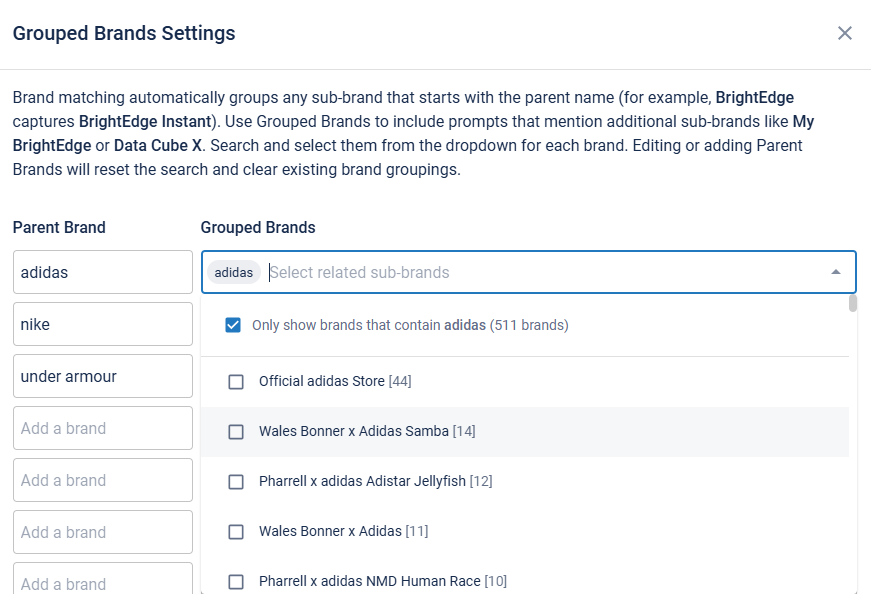
Use brand grouping to create a consistent definition of who your brand is. A short name, a legal name and a product name are three brands to an AI engine. Create a standard definition of a Grouped Brand to represent all your brand names.

Grouped Brands Settings in BrightEdge AI Catalyst

Grouped Brands Settings in BrightEdge AI Catalyst. Brand matching groups any sub-brand that starts with the parent name, and additional sub-brands are selected per parent brand so that every name a company answers to is measured as one.

Compare the engines against each other. ChatGPT and Google AI Overviews ranked the same three names differently here. A reading taken from one engine is half the picture.

Record the baseline before any branding change. A rename, a merge or a retirement can only be assessed against a measured starting position. Put the current names on record first, then track the same set through the change.

Work on the questions that carry the volume. Among the top prompts analyzed by estimated volume, live events lead on both engines. An evergreen how-to-watch page answering time, channel and stream covers the largest category in that sample.

Technical Methodology

FieldValue
CapabilityBrightEdge AI Hyper Cube, brand mention comparison
EnginesChatGPT and Google AI Overviews
WindowSeptember 2026, monthly cadence. One month, read as a snapshot rather than a trend
MarketUnited States only
Prompt filterNone. An earlier working cut excluded prompts containing a brand name by substring, which also drops every prompt containing "max" and therefore undercounts Max. That filter was not applied here
Brand setThirteen streaming brands. Share figures are relative to this set and change if the set changes
Share metricpercent_of_mentions, a brand's mentions divided by total mentions across the measured set
Metric not usedshare_of_mentions in the same response is volume-weighted, being a brand's share of the search volume associated with the prompts where it was mentioned. It is a different measure and is not reported in this edition
Combined figureThe 21.35% and 21.11% totals add six individual shares. Because the metric counts mention instances, the sum is the six brands' share of all mention instances across the thirteen. It is not the share of prompts in which at least one of the six appears. That is a different metric with a different denominator, requiring prompt-level deduplication, and it is not reported here
TimingAI Hyper Cube monthly coverage runs to September 2026. Every figure predates the 6 October 2026 close
Prompt mixCategories in Table 3 come from BrightEdge Professional Services analysis of the top 60 to 100 prompts by estimated volume per engine, categorized by keyword rules. The shares describe that sample, not every question put to either engine. Single large prompts can move the mix. Indicative only
Not measuredClicks, sessions, subscribers, revenue. Why any brand was mentioned. Customer sentiment. What any name would be worth after a branding change. Any engine other than ChatGPT and Google AI Overviews. Any market outside the United States
Brand name historyHBO Max launched in 2020, was renamed Max in 2023 and returned to HBO Max in July 2025. Source: Warner Bros. Discovery, Variety and The Hollywood Reporter, May and July 2025
Company namingParamount Skydance acquired Warner Bros. Discovery, and the combined company is named Skydance. Source: CNBC and Variety, October 2026
Deal factsAxios, 6 October 2026

What Is Still Open

How Skydance handles the merger remains to be seen. The earlier Warner Bros.-Discovery merger left many brand names in place. With three major streaming platforms (HBO Max, Paramount+ and Discovery+) and new leadership, branding decisions, as we have shown, can have long-running implications for how you show up in AI.

  • Whether the position moves after the close, which only post-merger data can show.
  • Whether the engine disagreement holds. One month on two engines in one market is a snapshot. A second month would show whether ChatGPT's preference for HBO and Google AI Overviews' preference for Max are stable.
  • Whether the conversation mix holds. The prompt-mix categories come from a single month's top prompts and have not been reproduced independently.

Key Takeaways

FindingSupporting evidence
AI answers saw six brands, not one companyParamount+, HBO, Max, HBO Max, Pluto TV and Discovery+ measured separately on both engines
Together they ranked second to Netflix21.35% on ChatGPT and 21.11% on Google AI Overviews, against Netflix at 27.93% and 28.23%
Three of the six are HBO-related namesHBO, Max and HBO Max are measured as three separate brands by both engines
The engines reach for different onesChatGPT mentions HBO most often at 1.59x the next of the three; Google AI Overviews mentions Max most often at 1.07x
An older name can stay prominent after a rebrandMax returned to the HBO Max name in July 2025, and Google AI Overviews still mentions Max more often
September is a baseline, not a forecastThe figures show where each name stands before the close, and a branding change would need the same names tracked through it
Ownership questions are a small share of the volume analyzedUnder 1% on both engines, among the top prompts by estimated volume

Frequently Asked Questions

Which streaming brands are the biggest in AI?

Across thirteen streaming brands in the United States, Netflix led on both engines, at 27.93% of brand mentions on ChatGPT and 28.23% on Google AI Overviews. The six Paramount and Warner Bros. Discovery names together held 21.35% and 21.11%, ahead of Apple TV, Hulu and Disney+.

Do ChatGPT and Google AI Overviews treat HBO, Max and HBO Max as the same brand?

Neither does. Both engines record a mention against the specific name used, so the three are measured as three brands. The engines also reach for different ones: ChatGPT mentions HBO most often, at 1.59 times the next of the three, while Google AI Overviews mentions Max most often, at 1.07 times. HBO is also a channel and a programming brand, not only a streaming label, so the three are related names rather than interchangeable ones.

How often does Google AI Overviews mention Max versus HBO Max after the rebrand?

In September 2026, Google AI Overviews mentioned Max in 5.05% of brand mentions across thirteen streaming brands, against 2.33% for HBO Max. The service had returned to the HBO Max name in July 2025, more than a year earlier. ChatGPT had the two closer together, at 3.11% for Max and 3.47% for HBO Max. This research records that the older name is still in use on both engines. It does not establish why, and a single month cannot show how long a name change generally takes to register.

How should a merged company measure AI visibility through a brand name change?

Record the position of every name involved before the change, on each engine, then measure the same set afterwards. This research is an example of the first half: September 2026 positions for all six names, on ChatGPT and Google AI Overviews, taken before the deal closed. It does not forecast what any name would be worth after a change, and no measurement taken before one can.

Does this research measure the effect of the Paramount and Warner Bros. Discovery merger?

No. Every figure is September 2026 and the deal closed on 6 October 2026, so this describes the position Skydance inherited. October data is not yet available. The first post-merger read is the one that can show movement.

What do people ask AI about streaming services, among the highest-volume prompts?

Among the top 60 to 100 prompts by estimated volume on each engine, live events lead at 65% on ChatGPT and 73% on Google AI Overviews. Where to watch a specific title follows at 15% and 22%. Questions about who owns which service account for under 1% on both. These shares describe that sample rather than every question put to either engine.

What does share of brand mentions measure, and what does it not?

It is a brand's mentions divided by total mentions across the brands measured, inside AI answers. It does not measure clicks, traffic, subscribers or revenue, it does not establish why a brand was mentioned, and it does not predict what a name would be worth after a branding change. It depends on the brand set chosen, so a different set gives different shares.

Source: BrightEdge AI Hyper Cube. Share of brand mentions across thirteen streaming brands, United States, September 2026, on ChatGPT and Google AI Overviews. Deal facts from Axios, 6 October 2026. Brand name history from Variety and The Hollywood Reporter.

More from this series

See the rest of the Weekly AI & Search Insights series.

Download the Full Report

Published on October 29, 2026

Subscribe for Weekly Updates