



97% of Top Websites Aren’t Ready for AI Agents. BrightEdge Launches New Platform Agent Edge to Change That.

97% of Top Websites Aren’t Ready for AI Agents. BrightEdge Launches New Platform Agent Edge to Change That.

Agent Edge helps enterprises optimize the point of interaction with AI agents across search, AI answers and agent-led discovery

SAN MATEO, Calif.—August 26, 2026—BrightEdge, the global leader in AI-powered organic search, today announced its new search solution Agent Edge, designed to help brands understand, optimize and act on the rapidly growing interactions between AI agents and enterprise websites.

AI agents are evolving from systems that simply retrieve information into increasingly capable digital assistants that research products, compare options, check availability and take multiple steps on behalf of people. BrightEdge believes these interactions are creating a “Second Web” — a new layer of access that creates a second audience for enterprise content: AI agents acting on a person’s behalf, often before that person ever visits the brand’s website, not a replacement for the web built for people or search engines.

The Second Web and The Point of Interaction

At the center of the Second Web is a new point of interaction between the brand and the agent. As AI systems gain more autonomy, the quality of that interaction can influence what information an agent finds, how efficiently it understands a brand and whether that brand ultimately becomes part of an AI-generated recommendation.

Yet most enterprises are not prepared for this shift. BrightEdge research found that 97% of the top 20,000 websites are not currently set up to serve AI agents in optimized formats such as Markdown, which can significantly reduce the amount of content an agent needs to process.

In separate BrightEdge research analyzing ChatGPT recommendations across nine industry categories from June 2025 to June 2026, ChatGPT was found to be researching more but recommending less: the number of sources it cited per answer nearly doubled (+89%), while the number of brands it recommended fell by around 25%. E-commerce saw the steepest decline, with recommendations dropping from roughly six brands to four, while B2B tech held steady at around four.

More than half (61%) of the sites analyzed have implemented schema, an important foundation for helping machines understand website content. But schema alone does not create an agent-optimized experience. Only a small fraction of sites have taken the additional step of serving content specifically designed for AI agent consumption, with early adopters including WordPress, Cloudflare, Linktree and Zendesk.

“AI agents are getting dramatically better at doing the work people once had to do themselves,” said Jim Yu, CEO and co-founder of BrightEdge. “They are researching, comparing and taking action on our behalf, making the point of interaction between an agent and a brand increasingly critical. The companies that can understand and optimize those interactions will have a significant advantage as this second audience grows.”

Giving AI Agents a Faster Path to the Right Information

Traditional websites were built for people and browsers, often requiring AI agents to process complex HTML, JavaScript, navigation and other elements that add little value to machine research. Agent Edge recognizes agent requests at the CDN layer and serves content in a format designed for how agents process information — minimizing wasted tokens and maximizing the value of the information delivered in each request.

Agent Edge then uses BrightEdge intelligence to anticipate the questions an agent is likely to ask next and enrich the content with relevant, data-informed answers — building on the content brands have already invested in rather than requiring them to create a separate experience from scratch. Instead of forcing the agent to return repeatedly to fill in missing context, Agent Edge gives it a more complete response up front, reducing unnecessary processing and minimizing the number of requests needed to complete its research.

In an early deployment with Arm, the semiconductor and software design company behind billions of devices, BrightEdge reduced the payload served to AI agents by approximately 90%. Within weeks, verified AI agent traffic to optimized content more than doubled and, on some pages, tripled.

Another early Agent Edge customer, Bloomfire, saw a 30% lift in direct AI referral traffic following implementation, demonstrating how optimizing the agent experience can translate into measurable discovery and traffic gains.

“We’ve spent years thinking about how people move through our content. Now we also have to think about how agents move through it,” said Brian Zander, VP of Marketing for Bloomfire and early user of Agent Edge. “Agent Edge helps us understand where those interactions are happening, what information agents need, and how to make that experience more efficient without rebuilding the site around a new channel.”

Agent Edge puts the content brands have already invested in to work for AI agents without requiring a separate content operation. Like offering a translated menu to a traveler, it presents the same trusted information in a format designed for how agents consume it.

From there, Agent Edge creates a continuous loop that helps brands:

  • Reveal the invisible audience: See which AI agents are interacting with the brand, what they are trying to access and how that behavior is changing.
  • Shape the interaction at the source: Optimize the point where agents meet the business, so they get the right information in the right format with less friction.
  • Turn existing content into an agent advantage: Extend the value of content brands have already created instead of building a separate AI content operation from scratch.
  • Connect agent performance to the broader search strategy: Bring agent interactions into the same intelligence layer as SEO and AI Search, so brands can optimize across all three rather than manage them in silos.

Together, these capabilities give brands a way to actively shape performance across the Second Web while connecting it back to the search and AI investments already driving visibility today.

Building for a Web That Is Still Taking Shape

Agent Edge extends BrightEdge’s Optimize Once, Win Everywhere vision by bringing agent-led discovery into the same platform brands already use to optimize traditional search and AI answers.

Because these capabilities operate on one platform, the same content, data and intelligence can inform every surface — helping brands avoid fragmented strategies as search and agent behavior continue to evolve.

“The Second Web will not be built all at once,” Yu added. “It will emerge interaction by interaction as agents take on more responsibility for researching and acting on behalf of people. Our goal is to give brands one connected platform to understand and optimize those interactions as they evolve.”

Learn more about Agent Edge and how BrightEdge is helping brands optimize across search, AI answers and the Second Web at https://www.brightedge.com/agent-edge

About BrightEdge

BrightEdge helps enterprise brands get found, cited and chosen across search engines, AI answers and AI agents. The BrightEdge platform connects SEO and AEO in one workflow, from understanding demand to acting on it and proving the revenue result. Founded in 2007 and self-funded since 2013, BrightEdge serves half of the Fortune 500 from nine offices worldwide.

CONTACT: press@brightedge.com

Press Release Date

BrightEdge Launches AI Hyper Cube, Pulling Back the Curtain on How Brands Show Up in AI Search

BrightEdge Launches AI Hyper Cube, Pulling Back the Curtain on How Brands Show Up in AI Search

As generative AI reshapes the buying journey, AI Hyper Cube reveals the hidden AI conversations shaping demand

SAN MATEO, Calif. — MARCH 10, 2026 — BrightEdge, the global leader in enterprise SEO and AI-driven organic search intelligence, today announced AI Hyper Cube, a new platform designed to help brands understand and influence how they appear across AI-powered search and discovery environments like ChatGPT, Gemini, and other generative AI engines.

“The companies that win in the next era of search will be the ones that understand how they appear in AI search and why,” said Jim Yu, CEO at BrightEdge. “It’s no longer just about visibility in search results. Brands need to know where they show up in AI-driven customer journeys, how those systems evaluate them, and which sources shape those outcomes so they can influence recommendations and capture demand.”

BrightEdge also introduced “AI Agent Insights,” a new capability that gives brands visibility into how AI agents interact with their websites. AI Agent Insights helps marketers understand which AI systems are visiting their digital properties, what they are doing, and where they encounter technical friction, including blocked pages, broken paths, and other barriers that may limit visibility in an increasingly agent-driven web.

Together, AI Hyper Cube and AI Agent Insights give organizations both an external view of how AI platforms represent their brands and an internal view of how AI agents access and experience their digital presence.

A New Search Capability for the New Search Era

However, most marketing and search tools were built for a pre-AI search environment, leaving brand leaders with little visibility into the hundreds of thousands of AI prompts shaping their category — including:

  • Which AI prompts mention their brand
  • What sources AI systems rely on when generating recommendations
  • How competitors appear alongside them in AI responses
  • Whether AI-generated narratives about their brand are positive, neutral, or negative
  • Where AI is amplifying older issues (e.g., outdated reviews, legacy news, historical controversies) into today’s buying journey

BrightEdge research shows that AI engines frequently rely on a concentrated set of sources when generating recommendations. In some industries, the top five publishers and platforms account for a quarter of all citations in AI-generated recommendations, significantly shaping how brands appear in AI responses.

AI Hyper Cube addresses this, making AI-driven decisions visible, showing the prompts that matter, the sources that drive outcomes, and where brands appear or are missing across the AI customer journey.

Rather than simply identifying platforms that matter, AI Hyper Cube pinpoints the exact content influencing AI recommendations. This allows companies to identify opportunities to win citations, influence recommendations, and strengthen brand presence in AI-driven discovery, while also diagnosing reputational and revenue risks.

With AI Hyper Cube, organizations can analyze how they appear across the full AI-driven customer journey, answering three critical questions:

  1. Which conversations are we part of?
  2. Who is starting these conversations?
  3. How can we get more visible and with the right story?

This analysis helps brands identify where they are strong or missing across different stages of the journey and take more precise actions to influence AI recommendations and capture demand.

By transforming AI search from an opaque environment into a measurable channel, AI Hyper Cube helps companies identify where they do and do not appear across the AI-driven research journey. The platform then translates those insights into actionable strategies across SEO, content, digital PR, and marketing — enabling brands to strengthen visibility in AI-driven discovery while continuing to optimize for traditional search performance.

Transparency in the Algorithm

Built on BrightEdge’s extensive data platform, spanning hundreds of millions of queries and billions of data points across industries, AI Hyper Cube analyzes how brands appear across AI-driven discovery.

For the first time, marketers can see which conversations drive demand at each stage of the AI customer journey, where their brands appear or are missing, and how AI systems evaluate them relative to competitors.

AI Hyper Cube also reveals the exact sources shaping AI recommendations, enabling brands to understand precisely what content influences AI responses for important prompts.

BrightEdge analysis shows that in some industries, the top five sources account for more than a quarter of AI-generated brand recommendations, and that citation visibility among those sources can shift by as much as 100% month-to-month, underscoring the need for continuous monitoring as AI systems evolve.

With this level of visibility, organizations can identify where they are strong or underrepresented across the journey and prioritize actions across SEO, content, digital PR, and partnerships that will influence AI recommendations and capture demand.

BrightEdge Spark: New Event Series on the Future of AI Search

To mark the launch of AI Hyper Cube and explore the future of AI-driven discovery, BrightEdge is hosting Spark, an event series bringing together marketing leaders, AI experts, and digital strategists to discuss how generative AI is transforming search and brand discovery.

The first Spark event will take place in San Francisco on March 10, followed by a second event in New York, on March 12.

These events will feature discussions on how AI is reshaping search behavior, new data insights into AI-driven discovery, and demonstrations of how AI Hyper Cube helps brands navigate this new landscape. Additional information can be found at https://www.brightedge.com/Spark26-live 


About BrightEdge

BrightEdge helps enterprise brands get found, cited and chosen across search engines, AI answers and AI agents. The BrightEdge platform connects SEO and AEO in one workflow, from understanding demand to acting on it and proving the revenue result. Founded in 2007 and self-funded since 2013, BrightEdge serves half of the Fortune 500 from nine offices worldwide.

Contact: press@brightedge.com

Press Release Date

How Claude Cites Sources: What Marketers Need to Know

Claude names vendors and consumer platforms, but it cites standards bodies, government and reference sources first. Here is what the data shows and what to do about it.

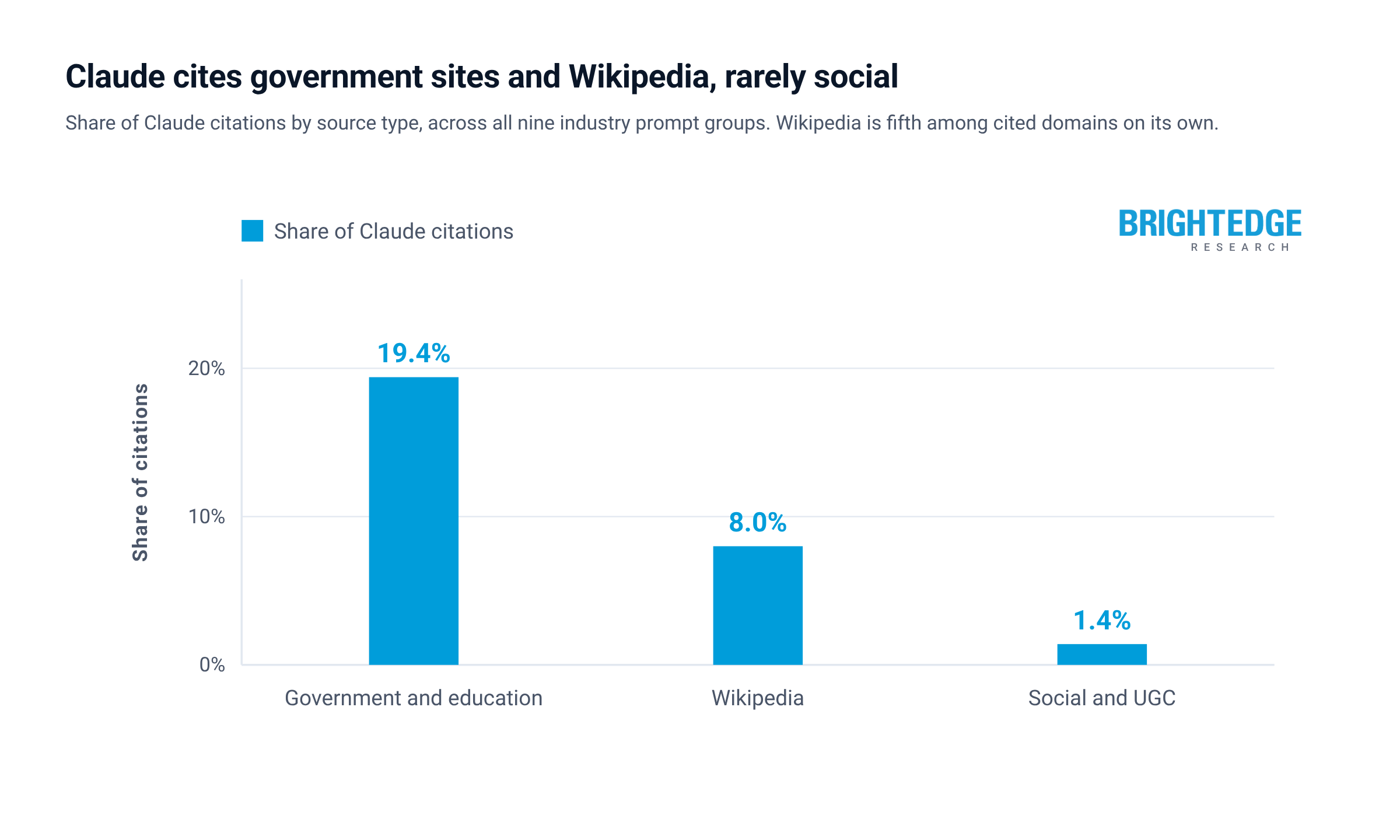
Across nine industry prompt groups, government and education domains accounted for 19.4% of Claude's citations, compared with just 1.4% for social sources.

Being mentioned in an AI answer does not mean your website is being cited as a source. Anthropic's record IPO brought Claude into the spotlight this week. The data on this page comes from AI Catalyst.

In BrightEdge data across nine industries, Claude names consumer platforms and clinical brands most often and cites government, standards and reference sources heavily. In B2B Tech it cites NIST and CISA ahead of vendor sites, while analyst, review and social sources rarely appear in its answers this week.

That makes brand visibility, cited sources and technical content three connected things for an enterprise marketing team to examine, on top of the Google presence that still drives most discovery.

The B2B Technology prompts in this panel lean toward security and compliance. A set built around software purchasing could produce a different source mix.

Why it matters

Claude is small as a traffic source. In BrightEdge's October 2026 AI Market Pulse, Claude accounted for 0.4% of AI-specific search referrals, against 96.0% for ChatGPT, 2.1% for Gemini and 1.1% for Perplexity. October is the latest month that index carries. On the wider picture, the same page has Google at 85.9% of all search referrals and AI engines at 2.2% of the total.

So the case for paying attention to Claude does not rest on clicks. It rests on what Claude says about a brand to someone doing research before a purchase, and on whether the sources behind that answer say what you would say.

This panel shows what Claude cites, not who is asking.

What we measured

BrightEdge AI Catalyst tracks two things that are easy to conflate. A mention is when an answer names a brand. A citation is when it lists a domain as a source. A brand can be named often and cited rarely, and in this data that is exactly what happens to the largest vendors.

GroupMost mentionedMost cited
B2B TechMicrosoftnist.gov
eCommerceAmazonamazon.com
EducationBLSbls.gov
EntertainmentTicketmasterwikipedia.org
FinanceYahoo Financeyahoo.com
HealthcareMayo Clinicmayoclinic.org
InsuranceHealthCare.govhealthcare.gov
RestaurantsYelpyelp.com
TravelGooglegoogle.com

Which brands Claude names, by category

In seven of the nine prompt groups, the most-mentioned brand's own domain was also the most-cited source. B2B Technology and Entertainment were exceptions. That is a statement about the leaders in each group, not about every brand in it.

Consumer platforms and aggregators

Amazon leads eCommerce on both mentions and citations. Yahoo Finance leads Finance, Yelp leads Restaurants, and Google, Kayak and Skyscanner are the three most-mentioned brands in Travel. Where a category has a dominant aggregator, Claude tends to name it.

BrightEdge classifies brands and domains into publications, social and a third group it labels Other, which mixes retailers, platforms and some government bodies. That Other group accounts for 69% of mentions and 61% of citations. Publications account for 27% and 35%.

Clinical brands in health

Mayo Clinic leads Healthcare on both measures, with MedlinePlus and NIDDK close behind on mentions and medlineplus.gov and nih.gov close behind on citations. Claude reaches for clinical and government health sources rather than consumer health media.

Government and primary sources

Government and education domains make up 19.4% of Claude citations, counted by domain suffix, so they overlap the categories above. SEC EDGAR is the third most-mentioned brand in Finance and sec.gov the second most-cited domain in that group. Where an answer carries risk, Claude cites the authority behind the claim.

Where the pattern breaks: B2B Technology

B2B Technology is one of the two groups where the most-mentioned brand's own domain is not the most-cited source, and it is the one a B2B marketer has to read closely.

B2B Tech: who gets mentioned and who gets cited

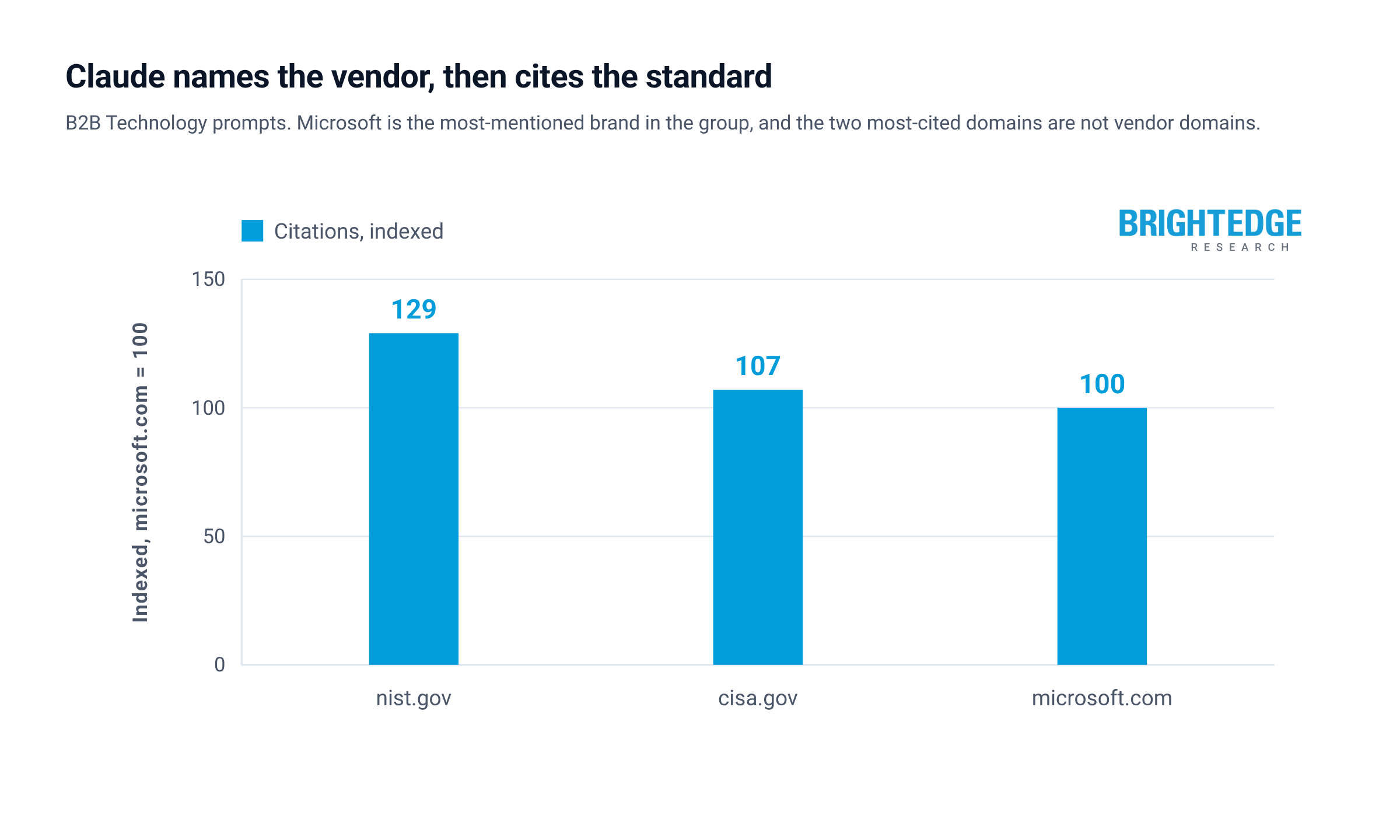
Microsoft is the most-mentioned brand in the B2B Tech group, ahead of Google and Amazon. The two most-cited domains in that same group are not vendor domains. They are nist.gov and cisa.gov. Indexed to microsoft.com at 100, nist.gov is cited at 129 and cisa.gov at 107.

Bar chart of Claude citations in B2B Technology, indexed to microsoft.com at 100. nist.gov is cited at 129 and cisa.gov at 107, both above microsoft.com at 100.

Figure 1. Claude citations in B2B Technology, indexed to microsoft.com at 100. Source: BrightEdge AI Catalyst, Claude, week of November 22, 2026. A single week on one engine, so it shows no trend.

Read it this way: Claude talks about vendors and backs the answer with a neutral authority. The gap between a mention and a citation is wide. Claude mentions Microsoft about 1.9 times for every time it cites microsoft.com.

Standards and documentation earn the citations

In the B2B Technology group, technical standards and documentation featured prominently among Claude's cited sources. Across all nine groups, Claude cites NIST about 16.6 times as often as Gartner, and NIST and CISA together are cited about 12.4 times as often as Gartner, G2 and Capterra combined.

The vendor pages that do get cited are documentation rather than marketing. Microsoft's most-cited pages are Learn documentation, on topics such as data loss prevention and SQL tooling, alongside its investor page. NIST's most-cited page is its Cybersecurity Framework. OWASP and GitHub both appear among cited domains.

Analyst and review sites barely register

Gartner, G2 and Capterra each receive a small number of citations. Forrester, TechTarget and McKinsey receive none at all in this week's data.

One caveat belongs with this section. The B2B Tech prompts in this panel lean toward security and compliance topics, which is visible in the sources themselves: NIST, CISA, OWASP and data loss prevention documentation. A prompt set built around software selection could return a different source mix, and this finding should not be generalized to all B2B buying without checking the prompts.

Where social and user content fit

Social accounts for 1.5% of mentions and 1.4% of citations across the panel. LinkedIn, YouTube and Reddit all appear, and all appear rarely.

Bar chart of Claude citations by source type across nine industry prompt groups. Government and education domains account for 19.4% of citations, Wikipedia 8.0%, and social and user-generated sources 1.4%.

Figure 2. Share of Claude citations by source type, counted by domain suffix. Source: BrightEdge AI Catalyst, Claude, week of November 22, 2026. A single week on one engine, so it shows no trend.

Wikipedia is the exception among reference sources. It is the fifth most-cited domain overall at 8.0% of Claude citations, and on its own it is cited about 23 times as often as LinkedIn, YouTube and Reddit combined.

What marketers should do

1. Publish documentation that maps your product to a named standard or framework. NIST, OWASP and the frameworks your buyers are audited on are the content types earning citations in this data, and they are usually owned by product and security teams rather than marketing.

2. Measure mentions and citations as two separate numbers. The gap is the finding. A brand can hold its place in the answer text while its own domain does not appear among the sources, and a single combined visibility score hides that.

3. Check crawler access before anything else. An engine cannot cite a page it cannot reach, so confirm which AI agents can request your documentation and what they receive.

4. Test which sources Claude cites for your buyers' actual questions. Technical documentation was prominent in this sample, but different prompt types may produce different source patterns.

5. Treat Claude as its own engine in reporting. The source mix here is not the source mix on other engines, so visibility on one does not predict visibility on another.

Frequently asked questions

What is the difference between an AI brand mention and a citation?

A mention is when an AI answer names your brand. A citation is when it lists your domain as a source. They diverge: in B2B Tech, Claude mentions Microsoft about 1.9 times for every time it cites microsoft.com. Earlier BrightEdge research on ChatGPT found a similar gap between mentions and citations.

How does Claude choose which sources to cite?

In this data, Claude cites government, standards, reference and clinical sources heavily, and cites social platforms rarely. Anthropic's documentation states that Claude automatically cites sources from the search results it retrieves.

How can I track brand mentions in AI search?

Track mentions and citations separately, by prompt group and by engine. Start with the questions your buyers actually ask, then measure your mentions and your citations separately. BrightEdge AI Catalyst reports both.

Does Claude cite Reddit, YouTube or LinkedIn?

Rarely in this data. All three appear, and social as a whole accounts for 1.4% of citations in the week measured. Wikipedia, by contrast, accounts for 8.0%.

Next steps

The practical test is your own prompt set. Results differ by industry in this panel, so the group a brand competes in matters more than any panel-wide average.

Run the same cut on the questions your buyers ask with BrightEdge AI Catalyst, check which AI agents reach your documentation with BrightEdge AI Agent Insights, and read the generative engine optimization guide for the wider picture across engines. Google remains the largest discovery channel by a wide margin, and AI search is the layer being added on top of it.

Methodology

Mentions and citations come from BrightEdge AI Catalyst, Claude, across nine industry prompt groups in the week of November 22, 2026. A mention is when an answer names a brand. A citation is when it lists a domain as a source.

Referral shares come from BrightEdge AI Market Pulse, October 2026, read on November 27, 2026. The IPO is described from CNBC, Bloomberg, CBS News and Axios, November 18 to 24, 2026.

This is one week of prompt data on one engine. Mentions and citations are counted, not clicks, leads or revenue. The panel records what Claude names and cites, not who is asking.

Download the Full Report

Download PDF

Click the button above to download the full report in PDF format.

Published on November 27, 2026

Subscribe for Weekly Updates

What Google's Classroom AI Sees

English, British
News Item Title
What Google's Classroom AI Sees
News Item Author Name
bloomberg
News Item Published Date
News Item Summary

Bloomberg examines Google's growing AI presence in US classrooms. Nearly 60% of mobile computers shipped to US schools last year were Chromebooks, a foothold that has helped Google embed itself across grading, parent communication and instruction. As AI spreads through Google Search, BrightEdge, the AI search and SEO platform led by CEO Jim Yu, finds that almost two-thirds of Google Search queries now return AI Overviews, putting AI answers in front of students even where schools restrict AI tools.

Google Shopping Dominating The European Product Search Results

English, British
News Item Title
Google Shopping Dominating The European Product Search Results
News Item Author Name
seroundtable
News Item Published Date
News Item Summary

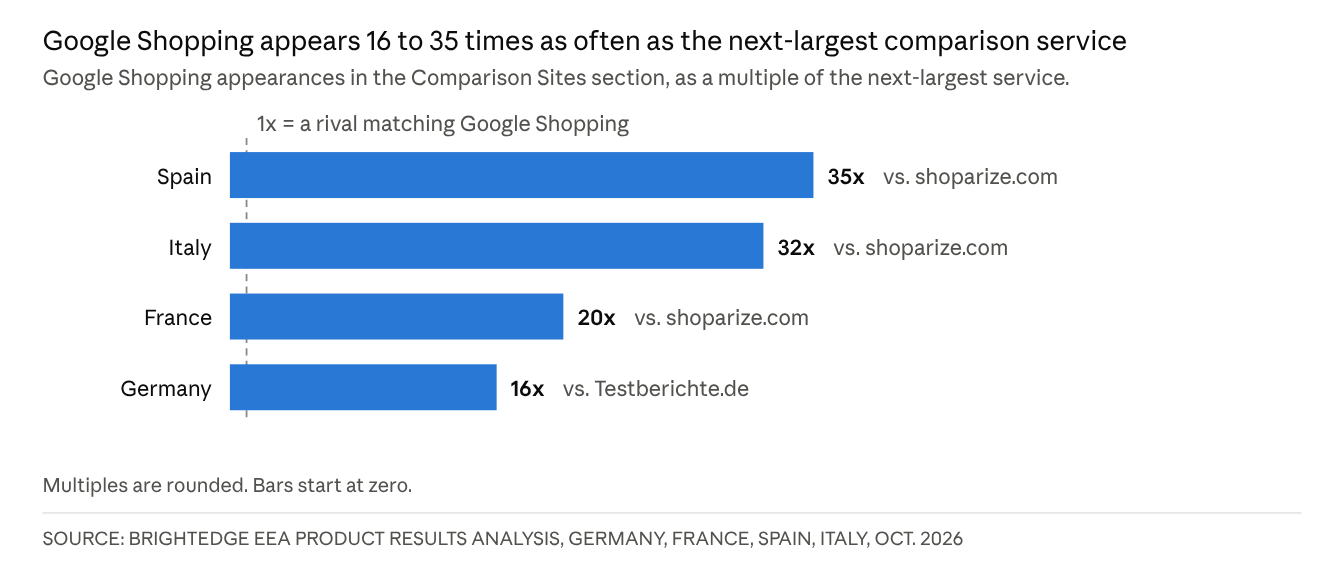
After Google dropped free product listings in Europe under the Digital Markets Act, a move Google called its biggest-ever reduction in search quality, data from BrightEdge, the AEO and SEO platform led by CEO Jim Yu, shows Google Shopping appears 16 to 35 times more often than the next-largest service in the new comparison box. Across Spain, Italy, France and Germany, 71% of these appearances landed in the top four result positions.

AI Becomes Retail's New Gatekeeper, Best Buy Wins Black Friday

English, British
News Item Title
AI Becomes Retail's New Gatekeeper, Best Buy Wins Black Friday
News Item Author Name
Media post
News Item Published Date
News Item Summary

New BrightEdge data shows Best Buy and Walmart often beat Amazon to the AI recommendation, especially when shoppers are ready to buy. When AI chooses the store, Best Buy appears in 65% of Black Friday answers on Google AI Overviews, ahead of Walmart (59%) and Amazon (50%). According to BrightEdge CEO Jim Yu, AI is now building the shopper's shortlist, with consumers brainstorming on ChatGPT, researching on Google, and then being directed to a store when ready to purchase

Enterprise AEO

Earn AI Citations Across All Your Brands and Markets

Every artificial intelligence (AI) answer is built from content across the web. ChatGPT, Google AI Overviews, Gemini and Perplexity decide which pages to read, which brands to name and which sources to cite. The engines’ choices shape which brands a buyer considers before visiting a single website. AI agents now act for buyers too: BrightEdge data released in April 2026 showed AI agent requests reached 88% of human organic search activity. An enterprise has to earn a place in AI answers for every product it sells and every market it serves.

Google is still the largest search channel, and AI search is growing quickly. BrightEdge measures both. BrightEdge is the enterprise AI visibility platform that measures how your brand appears across search, AI answers and AI agents. It turns the results into recommendations, activates fixes and reports the revenue impact of each change, with search engine optimization (SEO) and answer engine optimization (AEO) running as one connected workflow.

This guide explains what enterprise AEO is and the core work every AEO program needs. It then details the four requirements enterprise programs add: governance, combined reporting, global tracking and security. It closes with success stories from brands partnering with BrightEdge on AEO.

88% April 2026 Human organic search activity 100% AI agent requests 88%

What Is Enterprise AEO?

Enterprise AEO is the practice of measuring and improving how a large organization appears in AI-generated answers. It covers brand mentions, citations, sentiment and access by AI agents, and connects each one to traffic, conversions and revenue. The practice is also called generative engine optimization (GEO) or AI search optimization.

An organization counts as enterprise when it runs several business units, teams, countries, brands or languages, or operates at large scale.

AEO works the same way for any brand. At enterprise scale, it has to hold across thousands of pages, branded and unbranded buyer questions and the content, SEO and web teams that own each page.

Core AEO Work Connects Search, AI Answers and AI Agents

Every AEO program runs as a connected loop across search, AI answers and AI agents.

The same authority, content and technical signals drive rankings and AI citations, so BrightEdge runs SEO and AEO as one connected workflow, covered in more depth on Win in AI Search.

SEO + AEO one connected workflow AI Hyper Cube Data Cube X AI Catalyst Keyword Reporting AI Recommendations Content Advisor AI Agent Insights Analytics Reporting

Four Requirements That Let AEO Run Across the Whole Enterprise

Enterprise programs add four requirements to the core work. Together they let AEO grow from one team's project into a program the whole business runs on.

Governance

Clear Ownership and Permissions for Every Brand, Team and Agency

When content, SEO, web and agency teams all work on AI visibility, the program needs clear rules: who sees which data, who can change prompts and competitor sets, who approves content before it publishes and who owns each fix. Without clear ownership, teams can optimize the same page for the same prompt, and copy can publish before brand or legal teams approve it.

Login BrandBusinessMarket Business outcome

BrightEdge runs each brand, business unit or market as its own account under a shared login, with permissions set by the customer administrator. Prompt libraries, competitor sets and approved brand terms are managed per account, so each group tracks its own products and markets. AI Catalyst stores each AI answer in full next to its cited sources, so engine claims about products and pricing can be checked against approved brand terms. Content Advisor holds a review step before anything publishes, and Agent Edge lets teams choose which pages get an agent-ready version and edit that version before it goes live. Every recommendation moves into Jira or Asana with an owner and a due date. Agencies work inside the same environment as in-house teams, so partners follow the same rules and report from the same numbers.

What sets BrightEdge apart: the same accounts, permissions and workflows govern SEO and AEO, so one set of rules covers rankings, AI citations and agent-ready pages.

Combined Reporting

One View of AI and Search Performance for Leadership

Executives want AI visibility across the whole business, while each brand, market and team keeps its own detailed view. Leadership reports need AI and organic search results side by side, measured in referrals, conversions and revenue.

Organic search AI

BrightEdge reports AI share of voice, mentions and citations next to organic rankings, and connects AI referrals, conversions and revenue to the recommendations behind them. Custom reporting builds views by brand, product line and market, and integrations with Google Analytics and Adobe Analytics feed the revenue data. Anomaly Detection sends configurable alerts when brand presence or citation patterns shift. AI agent traffic from AI Agent Insights and Agent Edge reports in the same platform as search. BrightEdge MCP brings live results into ChatGPT, Claude, Microsoft Copilot and Slack for stakeholders who work outside the platform.

What sets BrightEdge apart: AI and organic results come from the same platform and share a decade of search history in Data Cube X, so leadership sees one trend line across search and AI.

Global Tracking

Accurate AI Visibility in Every Country, Language and Business Unit

To track AI visibility across markets, a global program needs prompt sets built for each country and language, competitor sets that change by region and results that can be compared across brands and business units. AI engines answer the same question differently in each market, and buyers in each market ask about different products.

ChatGPT Google AI Overviews Gemini Perplexity Claude Microsoft Copilot

AI Catalyst tracks mentions, citations, sentiment and answer position across ChatGPT, Google AI Overviews, Google AI Mode, Gemini, Perplexity, Claude and Microsoft Copilot, and every report filters by country, language, brand and persona. Accounts support prompt libraries of more than one million prompts. For retailers, BrightEdge Product Grid reports visibility at the product and stock keeping unit (SKU) level, including price and availability.

What sets BrightEdge apart: AI Hyper Cube attaches recorded demand to every prompt, so each market prioritizes the questions buyers ask most there.

Security

Security Controls Ready for Enterprise Procurement Review

Enterprise AEO brings brand, revenue and customer data into one platform, connects it to AI assistants and, with agent-ready pages, touches the live website. Security teams need to know who can access the data, how the vendor governs its own AI and what changes on the site.

Agent Edge Verified AI agents Optimized version Human visitors Original page ISO 42001:2023ISO 27001:2022ISO 27701:2019SOC 2GDPRSSO

Access is managed per account with permissions set by the customer administrator and single sign-on (SSO), and each customer's data is kept separate. BrightEdge is certified under International Organization for Standardization (ISO) 42001:2023 for AI management, alongside ISO 27001:2022, ISO 27701:2019 and System and Organization Controls 2 (SOC 2), and is compliant with the General Data Protection Regulation (GDPR).

On the website, Agent Edge runs at the content delivery network (CDN) through Amazon Web Services (AWS) CloudFront, Cloudflare and Akamai, so no page code or content management system (CMS) changes. It routes only verified AI agent requests to the optimized version of a page, while human visitors and Googlebot receive the original page.

What sets BrightEdge apart: Agent Edge changes only what verified AI agents receive, so search rankings and the human experience on the site stay as they are.

Enterprise Brands Growing From AI Visibility

Each story below starts with the scale that makes it enterprise. Full stories are in the BrightEdge case study library.

Global Tracking | NinjaOne

61% share of AI mentions in the IT operations category

NinjaOne serves nearly 40,000 customers in more than 140 countries and groups its AI prompt tracking by product line, audience and brand topic. In June alone, more than 20 people across four teams outside SEO logged in over 300 times.

NinjaOne brought SEO and AEO tracking into one workflow and built a weekly share-of-mentions report across every product group. The report decides which content gets refreshed and what gets written next, and public relations, affiliate, paid search and customer advocacy teams now pull from the same data. Within a year, NinjaOne’s share of AI mentions in the IT operations category grew from single digits to 61%, more than 20 points ahead of the next-closest brand tracked.

Read the NinjaOne story

AI Agent Access | Arm

−90% payload served to AI agents

AI agents were already reaching Arm’s content at scale, including its installation guides and AI and machine learning (ML) learning paths, so any change had to work without altering how Arm creates and publishes content.

Arm’s technical content was what AI agents valued most and what they found hardest to parse. Arm started with the pages AI agents fetched most, served them an agent-ready version without rebuilding a single page and then expanded across its high-value pages. The payload served to AI agents dropped by about 90%, and verified agent traffic to optimized pages more than doubled within weeks, tripling on some pages. Arm tracks agent traffic in the same view it uses for search.

Read the Arm story

Combined Reporting | Riskonnect

57% AI share of voice

Riskonnect helps organizations run risk, claims, compliance and resilience programs in one system and competes in a crowded risk management software market. Its team tracked 227 AI Overview rankings within four months and reports AI visibility to leadership as business metrics.

Riskonnect combined Data Cube X and AI Hyper Cube to build its prompt set from recorded demand, then identified the risk, compliance and resilience topics that appear most often in AI Overview responses. The team needed three views at once: AI Overview rankings, competitive standing in AI answers and proof that visibility drove traffic. Within four months, Riskonnect reached 57% AI share of voice, and organic traffic to its AI-optimized pages grew 495%.

Read the Riskonnect story

AI-Ready Content | Bloomfire

+30% AI referral traffic prior 90 days July 2026

Bloomfire helps organizations capture, organize and surface institutional knowledge. Its comparison and category pages are among the most visited on its site, and AI agents read the comparison pages on behalf of buyers.

Bloomfire wanted to serve AI agents without maintaining a second version of its website. With Agent Edge built on AWS, AI agents receive a version of each page made for how they read, while human visitors and search rankings stay as they were. Bloomfire measured a baseline, launched on a limited set of pages and expanded across the site once the results held. In July 2026, AI referral traffic rose 30% against the prior 90 days, agent traffic to optimized pages doubled and citations and mentions in AI answers grew over the same period.

Read the Bloomfire story

See How AI Engines Describe Your Brand Today

Enterprise AEO starts with a record of where your brand appears in AI answers across every market you serve.

Request a Demo 

Frequently asked questions

What is enterprise AEO?

Enterprise answer engine optimization (AEO) is the practice of measuring and improving how a large organization appears in AI-generated answers, whether that scale comes from several business units, brands, countries or languages, or from a website large enough to need shared rules and reporting. BrightEdge is built for enterprise AEO, with governance, combined reporting, global tracking and audited security on one platform.

What is an AI visibility platform?

An AI visibility platform tracks where a brand appears in AI answers, explains why competitors earn citations and connects results to revenue. BrightEdge combines AI Catalyst to track mentions and the sources that earn citations, Recommendations to compare pages with the ones that outrank them and Content Advisor to close content gaps.

Which AI visibility platform scales across brands and markets?

A platform scales when each brand, business unit and market runs its own prompt sets, competitor sets and permissions, while leadership sees one combined report. BrightEdge supports prompt libraries of more than one million prompts and filters every AI Catalyst report by country, language, brand and persona.

How do you measure AEO return on investment (ROI)?

BrightEdge measures AEO return on investment (ROI) by connecting AI share of voice, mentions and citations to AI referral traffic, conversions and revenue over time. It reports each metric by brand, product line and market next to organic search performance.

Which AI search optimization tools have the most historical data?

Historical depth separates a lasting trend from a one-week fluctuation in AI visibility. BrightEdge compares current AI answers against a decade of search history in Data Cube X, and AI Hyper Cube compares each prompt with its earlier answers.


 
×
Table of Contents
Table of contents

Europe's Product Grid Is Gone, but Google Shopping Still Leads the Replacement

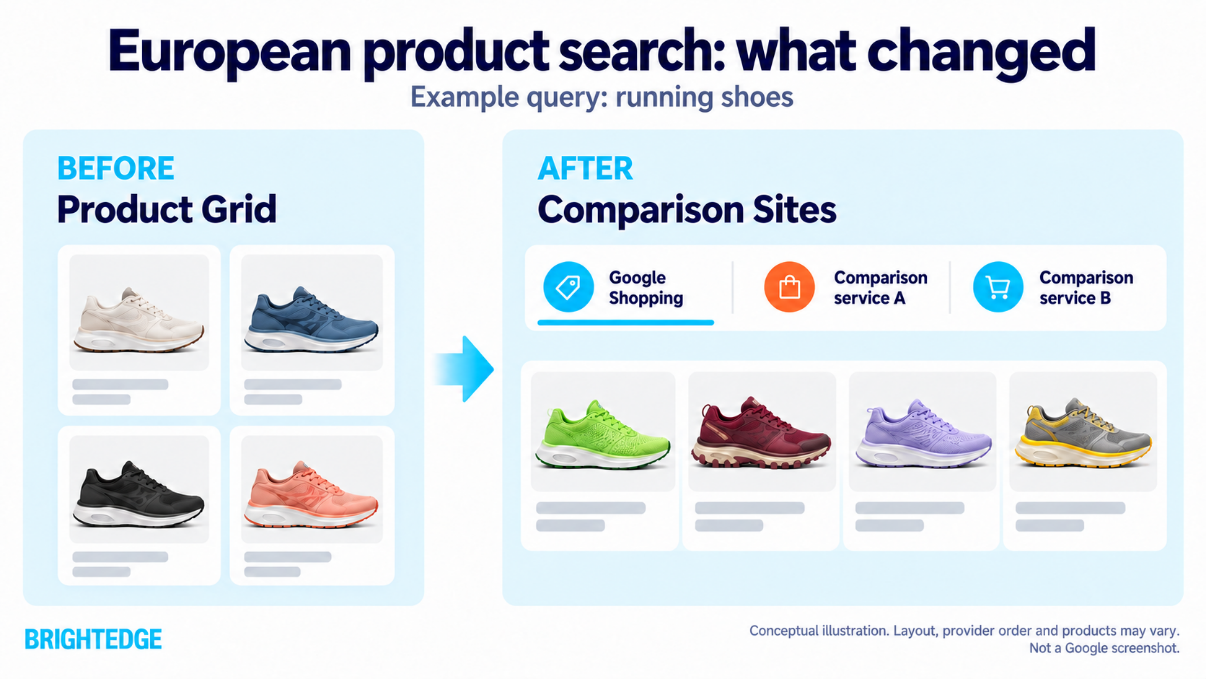
If you’re a retailer selling eCommerce in the European Economic Area (EEA), Europe’s single-market trade zone, you need to understand this change to your products’ coverage. Google’s free Product Grid, sourced from your Merchant Center Feed and Product pages disappeared overnight on September 16th Google replaced it with a Comparison Sites box meant to give rival shopping services a fair shot. Yet Google Shopping retained a substantial lead, appearing 16 to 35 times as often as the next-largest service in Germany, France, Spain and Italy.

While doing so, Google retained dominance, owning that space with the same products in 94%+ of all SERPs (Source: BrightEdge Total Search Visibility.).For retailers, the practical question is whether their priority products appear in those results. Check your free-listing eligibility in Merchant Center and whether third-party comparison catalogs carry accurate, current information about your products.

Illustration comparing a product grid with a Comparison Sites section containing Google Shopping and third-party services.

Key takeaways

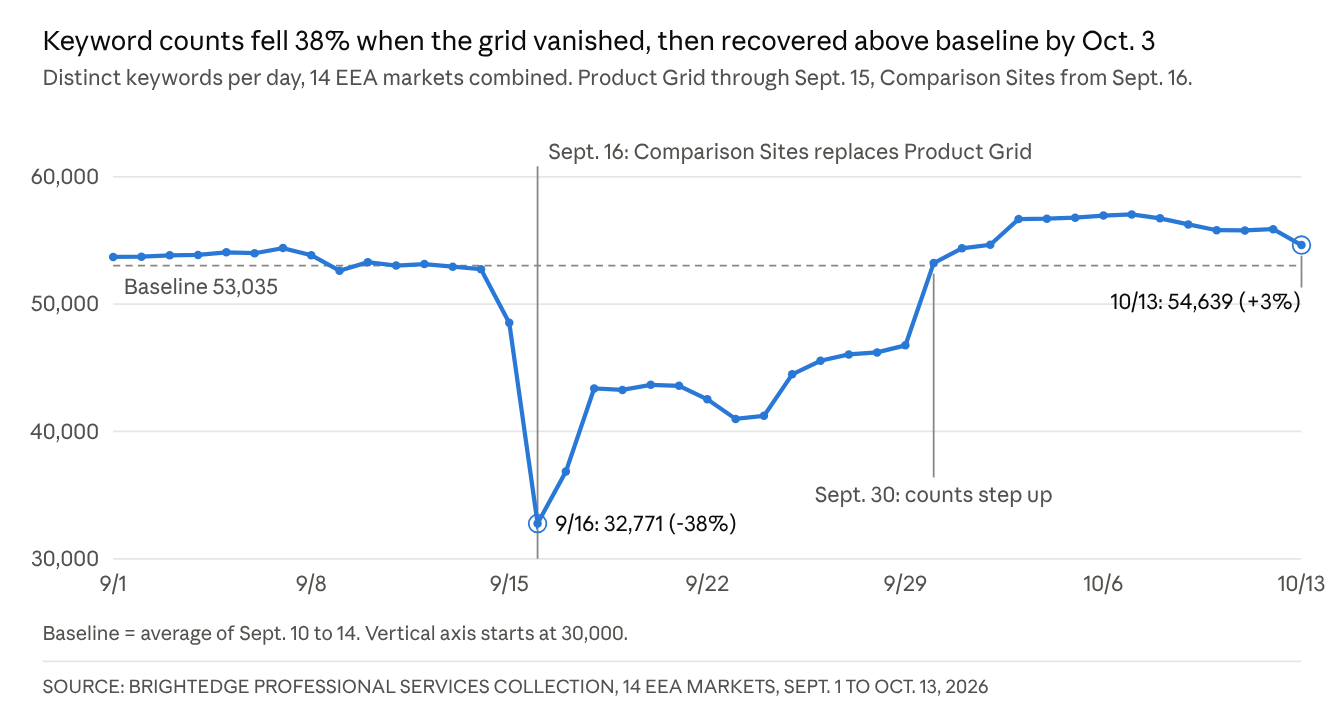
  • One date, every tracked market: Product Grid listings stopped appearing in all 14 EEA markets BrightEdge tracks, and Comparison Sites began appearing in the same 14 markets on the same day, Sept. 16.
  • A dip, then a recovery: The number of keywords showing a comparison section was 38% below the old grid baseline on day one, stayed roughly 12% to 23% below it through Sept. 29, then stepped back above it on Sept. 30.
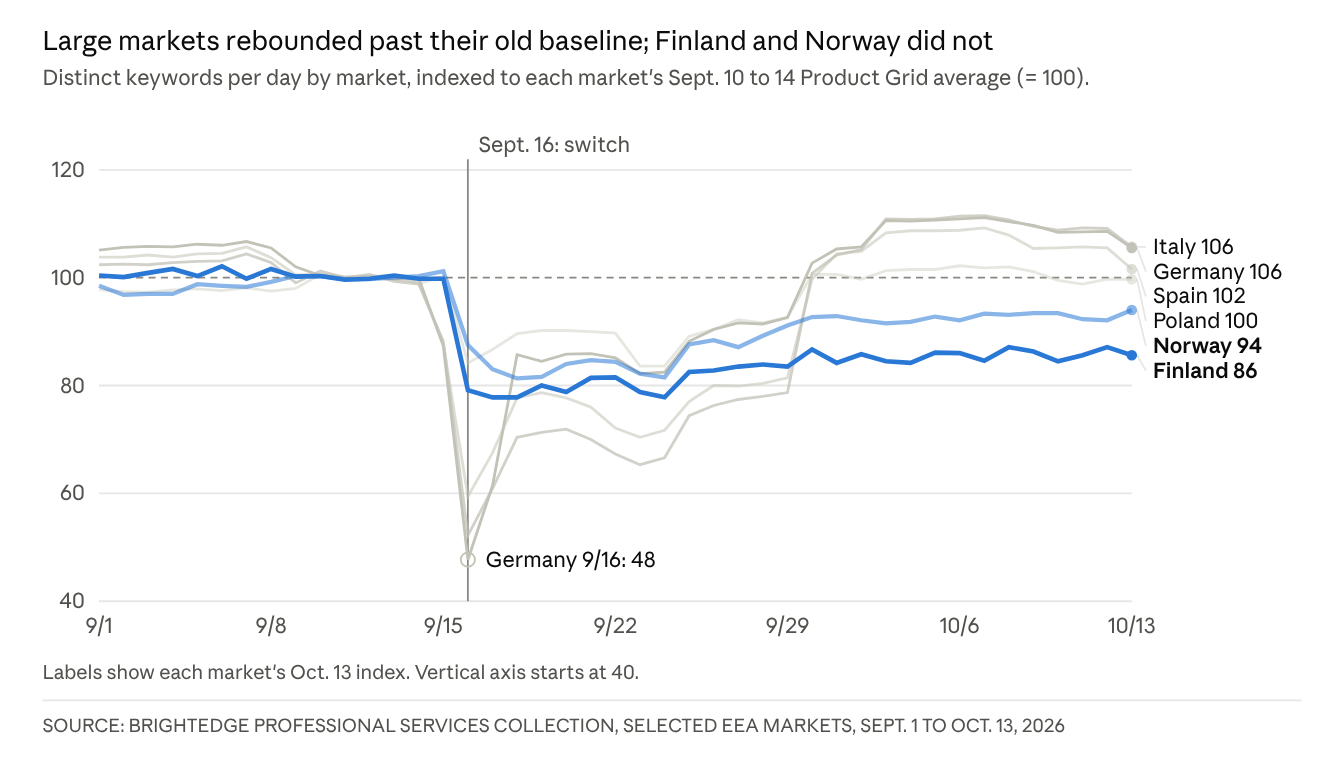
  • Not every market recovered: Germany, Italy and Spain climbed back above their baselines by Oct. 3, while Finland and Norway were still about 14% and 6% below theirs on Oct. 13.
  • Google Shopping leads the new box: It appears 16 to 35 times as often as the next-largest service, and 71% of Comparison Sites appearances land in the top four result positions.
  • What to do first: Opt into visibility and choose Google as the comparison shopping service (CSS) that places your free listings in Merchant Center given it's dominance in results.

Data collected

The figures come from BrightEdge Professional Services analysis of daily search results collection on a tracked product query set, not from AI Catalyst or AI HyperCube. This period covers the two weeks prior to the change for base-lining and the subsequent time period until metrics stabilized.

ItemDetail
Markets14 EEA markets: Austria, Belgium, Czechia, Denmark, Finland, France, Germany, Greece, Italy, Netherlands, Norway, Poland, Spain, Sweden. The UK, US, Canada and Australia serve as non-EEA comparisons
WindowSept. 1 to Oct. 13, 2026, daily
MeasureDistinct keywords per day showing a Product Grid (through Sept. 15) or a Comparison Sites section (from Sept. 16)
BaselineEach market's Product Grid average for Sept. 10 to 14, set to 100
Reading the countsCounts show volume, not whether the same keywords appear before and after
Share and position dataEEA product results analysis for Germany, France, Spain and Italy, Oct. 2026

Why the grid disappeared

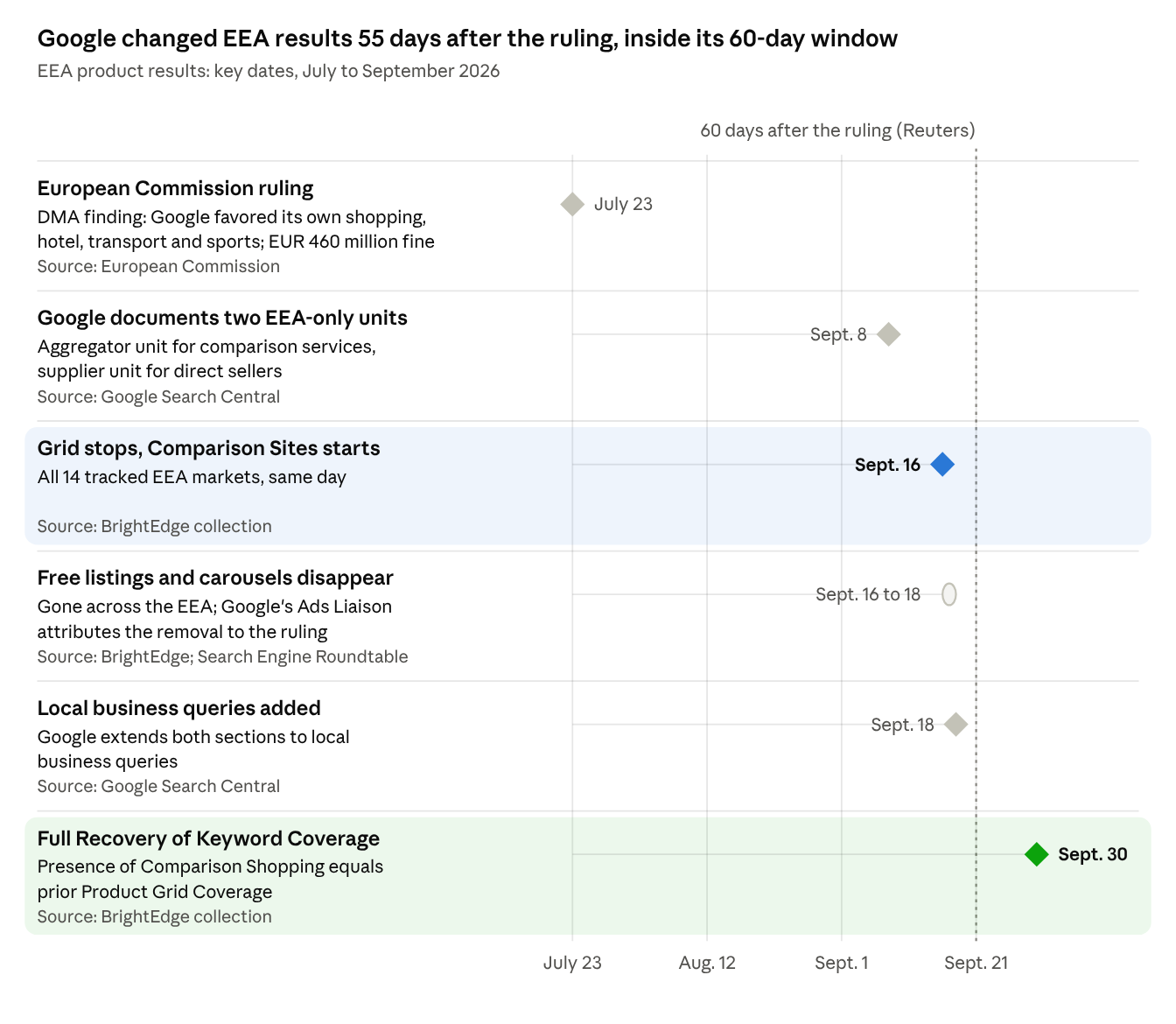
Google removed the grid to comply with a July 23, 2026 European Commission ruling under the Digital Markets Act (DMA), which found Google favored its own shopping, hotel, transport and sports results and fined it EUR 460 million for that finding (coverage). A separate EUR 430 million fine over Google Play brought the day's total to EUR 890 million.

Timeline of EEA product result changes from July to September 2026: the European Commission ruling on July 23, Google documenting two EEA-only units on Sept. 8, the grid stopping and Comparison Sites starting on Sept. 16, free listings and carousels disappearing Sept. 16 to 18, local business queries added Sept. 18 and full recovery of keyword coverage on Sept. 30

Google disagrees with the ruling and told Reuters on Sept. 8 that the changes are the largest reduction in quality of service in its 29-year search history. Reuters reported that Google had 60 days to comply, and the Sept. 16 change landed inside that window. Because this is a compliance step, there is no sign it reverses while the ruling stands.

Product grids vanished on one day, and keyword counts took about two weeks to recover

Line chart of distinct keywords per day across 14 EEA markets, falling 38% from a baseline of 53,035 to 32,771 on Sept. 16 when Comparison Sites replaced the Product Grid, then stepping up on Sept. 30 and reaching 54,639, 3% above baseline, on Oct. 13

Product Grid listings stopped appearing in all 14 markets after Sept. 15, and the Comparison Sites section began on Sept. 16, the same day everywhere. Day one counted 38% fewer keywords than the old baseline. Counts then sat at roughly 77% to 88% of baseline between Sept. 18 and Sept. 29, and stepped up on Sept. 30. Since Oct. 3 the combined count has held 3% to 8% above baseline. Product Grid stayed flat throughout in the UK, US, Canada and Australia, which sit outside the change.

Read this as a change in volume, not proof that the same keywords moved from one section to the other. The Sept. 30 step also hit the largest markets together, so part of the early dip may reflect the new section being collected and classified in stages.

Large markets rebounded past their old baseline; Finland and Norway never did

Line chart of keyword counts by market indexed to each market's Sept. 10 to 14 Product Grid average, showing Italy at 106, Germany 106, Spain 102 and Poland 100 on Oct. 13, while Norway stayed at 94 and Finland at 86

Germany, Italy and Spain took the deepest day-one hits (Germany fell to about half its old count) and recovered slowest, then jumped back above baseline on Sept. 30 and reached about 108% to 111% of it by Oct. 3. Poland dipped less and settled at baseline. Finland and Norway took smaller early hits, missed the Sept. 30 step, and were still about 14% and 6% below baseline on Oct. 13.

Finland and Norway are small markets where a few dozen keywords move the index, so treat them as markets to watch, not proof of lasting loss. The six markets shown are the clearest examples of each pattern; the other eight markets mostly follow the large-market or Poland shape.

Google Shopping leads the new box in every market, for now

Bar chart showing Google Shopping appearing 35 times as often as the next-largest comparison service in Spain, 32 times in Italy, 20 times in France and 16 times in Germany

Across the four markets analyzed, 71% of Comparison Sites appearances fell in the top four result positions, from 61% in France to 76% in Spain and Italy, so the box is premium space.

The lead is wide today, but the ruling exists to give third-party services comparable prominence. Any service that qualifies or gains share moves visibility toward boxes that Merchant Center does not fill. BrightEdge has no data yet on how fast that happens.

Products still reach EEA searchers by two routes

The change moves where products appear more than whether they can, and it adds a dependency outside Google: part of a merchant's European product visibility now runs through comparison services and the feeds that supply them.

RouteFed byWhat the searcher seesMerchant lever
Google Shopping boxMerchant Center feed, product and offer schema, page contentProduct tiles that open the multi-seller product panel the old grid used, or the Google Shopping pageFeed quality, and selecting Google as the CSS for free listings
Third-party service boxes (idealo, billiger.de, Bigshopper and others)Each service's own catalog, fed by direct feeds, affiliate networks or feed-management partnersA box with one service expanded and others collapsed beneath itPresence and data accuracy in each service's catalog

Google's merchant help says a merchant places free listings through one CSS, chosen in the Merchant Center CSS dashboard, and Google Shopping is one of the options. Because you can only opt for one CSS through the free listings, and with Google outranking other CSS's by more than 16x, we recommend you select Google as your preferred CSS. BrightEdge has not yet tested how a merchant who selects another CSS shows up inside Google's box, and does not recommend a non-Google CSS unless required.

Two business models face extra limits. Google bars a primarily marketplace business from operating as a comparison service, though it can list through one. Comparison-service rules also bar links to merchant sites that sell only to businesses, which narrows the third-party route for a business-only checkout.

Ordinary organic listings keep their role. With the grid gone they have one fewer feature to clear, which puts more of the organic load on product and category pages.

Start here: priority actions

If you do one thing this week, check which CSS your Merchant Center account uses for free listings. It is entirely in your control and it decides which service places those listings. Beyond that, feed hygiene still matters but is no longer the whole job: four actions are urgent, two need evaluation, and one needs monitoring.

PriorityActionWhy
Do nowSelect Google as the CSS for free listings in each Merchant Center account (several CSSs can be selected for paid campaigns, only one for free)Google Shopping holds the leading box in every tracked market
Do nowList the comparison sites and affiliate partners that carry your products in each EEA market, and the feed behind eachThird-party boxes fill from their own catalogs, so presence is decided outside Google
Do nowAlign titles, images, price, availability and GTIN across partner feeds and the Merchant Center feedA product should read the same in every box, and a shared identifier lets each service match the right offer
Do nowRe-baseline EEA product visibility from Sept. 16 and stop comparing it with earlier periodsBefore and after measure different page layouts
EvaluateMap coverage gaps by category and market where no service other than Google Shopping lists your rangeThese gaps lose visibility first if third-party services gain share
EvaluateFor price-comparison or marketplace properties, assess the CSS program and Google's structured data carousel (beta)The comparison side of the section is application-gated
MonitorTrack UK product grid visibility and each service's share of the Comparison Sites section in the EEAA falling Google share is the early signal of a third-party shift

Six best practices for product visibility in the EEA

Google builds a product listing from inputs it reads from your catalog, and retailers directly supply three of them: the product feed, the structured data on the product page, and the web content describing the product. Those same inputs now feed the Google Shopping box, the third-party services that ingest your data, and Google's AI surfaces. Most lost visibility traces to gaps in these inputs, not to a missing strategy, which makes it fixable data work.

InputWhat it doesThe common gap
Merchant Center feedThe structured catalog Google ingests for Shopping, free listings and AI surfacesMissing or invalid attributes, identifiers or disapprovals quietly suppress products
Product pageThe page Google crawls, and the page that has to earn the clickThin or unrenderable pages do not earn ranking, or the click when they do appear
Structured dataConfirms what the product is: price, availability, brand, reviewsWithout valid Product and Offer markup, Google cannot confirm price, availability or reviews

1. Fix the Merchant Center feed first

A product that is disapproved or missing identifiers is not eligible for the surfaces that matter, so start with approval and completeness. Review disapprovals and warnings, identifiers (GTIN, MPN, brand), title, attribute and image quality, and the accuracy of price, availability and shipping information.

Shipping accuracy matters more than most teams expect. In one BrightEdge Professional Services analysis for a national home improvement retailer, a competitor lost visibility every weekend because its 2-day shipping applied only on business days. The client gained traffic after supplying more accurate, up-to-date shipping information in its Merchant Center feed.

2. Choose your comparison shopping service on purpose

In the EEA, a retailer's free listings run through one comparison shopping service (CSS), chosen in the Merchant Center CSS dashboard. Select Google Shopping unless you are required to do otherwise, because it leads the section in every market measured. If the account's CSS is not the one selected, Merchant Center disapproves the products with the message CSS not selected for this destination. Then confirm, market by market, which service carries your free listings, and check that your products appear in the comparison-service results for each market. BrightEdge has not yet tested how a merchant who picks another CSS appears inside Google's box.

3. Make product pages complete and readable by machines

The page has to earn the click, and it has to be readable to the systems that assemble product answers. Serve price, variants, availability and reviews in the page code itself instead of loading them with client-side JavaScript. Most AI agents do not run JavaScript, and Adobe scored US retail product pages 66% machine-readable, the lowest of the page types it measured, and UK product pages averaged the same 66 out of 100.

To check, crawl a sample of product pages without JavaScript and compare what appears with the browser view, and confirm that server logs show AI crawlers fetching the full product content. Where pages are thin, add depth: specifications, sizing, delivery and returns, and trust signals such as reviews. BrightEdge's guide to AI agents covers the access and rendering checks in detail, and BrightEdge AI Agent Insights tracks which agents reach your pages.

4. Add and validate Product and Offer structured data

Structured data confirms what a product is. Use valid Product and Offer markup with price, currency, availability, brand and identifiers, add AggregateRating where you have reviews and BreadcrumbList for context, and cover every product template, not only the top sellers. The markup, the page and the feed should agree, because a mismatch between them undermines the confirmation that structured data exists to provide.

5. Describe every product the same way everywhere

The same product now appears in Google's box, in third-party comparison services fed by their own catalogs, and in AI shopping answers. Compare titles, prices, variants and product numbers across Merchant Center, partner and affiliate feeds, any AI shopping feeds you supply, and the product page. You know it is working when the same details appear in Google and in comparison-service listings for the same product.

6. Measure on a new baseline, and watch availability daily

Results before and after Sept. 16 come from different page layouts, so start EEA product visibility trends again from that date. Track Comparison Sites presence by market and, where you can, each service's share of the section. BrightEdge GSC Reporting is one place to watch clicks on either side of Sept. 16.

Watch the products that carry your visibility. A few products usually drive most of a retailer's product-surface presence, and an out-of-stock or suppressed item can erase it, a drop that Search Console alone can surface weeks late. Report AI-referred visits as their own channel beside organic search, so a shift between channels is visible rather than buried in organic.

EEA product visibility checklist

Feed and CSS

  • Merchant Center disapprovals and warnings reviewed, with no products suppressed by missing or invalid attributes
  • GTIN, MPN and brand present on every product that has them
  • Titles, images, price, availability and shipping information accurate and current
  • Google Shopping selected as the CSS for free listings in each Merchant Center account, or the reason for another choice documented

Product pages and structured data

  • Price, variants, availability and reviews present in the page code, not loaded only by client-side JavaScript
  • A no-JavaScript crawl of sample product pages compared with the browser view
  • Valid Product and Offer markup on every product template, with AggregateRating and BreadcrumbList where they apply
  • Feed, page and markup agree on price and availability

Partners and measurement

  • Comparison sites and affiliate partners that carry your products listed for each EEA market, with the feed behind each
  • Titles, identifiers and variants consistent across partner feeds
  • EEA product visibility trends re-baselined from Sept. 16
  • Daily availability monitoring on the products that carry most of your visibility
  • AI-referred visits reported as their own channel beside organic search

What we do not know yet

The biggest gap for a marketer is the traffic cost. This data measures visibility, not clicks or revenue. Directionally, BrightEdge has seen product page clicks decline and clicks to non-product pages rise alongside this change, but not clearly enough to say the pattern is consistent. Treat it as a lead to test in your own data, not a finding.

Three more questions would change this advice if they resolved differently:

  • Whether the supplier unit, Google's separate section for direct sellers, appears on product queries at all. No capture shows it yet.
  • How Google ranks the services inside the section. Its documentation omits this.
  • Where traffic from the section is reported in Search Console and Merchant Center. Google has not documented it.

How BrightEdge reporting treats the new layout is covered in the FAQ below.

Frequently asked questions

What happened to Google's product grid in Europe?

On Sept. 16, 2026, Google stopped showing its free product grid across the European Economic Area and began showing a Comparison Sites section, where comparison shopping services list products. The change followed a July 23, 2026 European Commission ruling under the Digital Markets Act that fined Google EUR 460 million for favoring its own shopping results.

Which countries are affected?

The EEA, which is the EU plus Iceland, Liechtenstein and Norway. BrightEdge measured the same-day switch in 14 tracked markets. The UK is outside the EEA and kept its product grid.

Is the product grid coming back?

BrightEdge sees no sign that it returns while the ruling stands. Google disagrees with the ruling, but the change is a compliance step.

What is a comparison shopping service (CSS)?

A comparison service that places products in Google results in Europe. A retailer can select only one for its free listings in Europe, and Google Shopping is one of the options. Google's guide to working with comparison shopping services covers the setup.

Should I use a CSS other than Google Shopping?

BrightEdge does not recommend it unless you are required to. Google Shopping appears 16 to 35 times as often as the next-largest service in the markets measured, and BrightEdge has not yet tested how a merchant who picks another CSS appears inside Google's box.

Does feed optimization still matter?

Yes. The feed, the page's structured data and the web content describing the product are the three inputs retailers directly supply behind a Google product card, and third-party comparison services ingest similar product data.

Did my traffic drop?

BrightEdge has directionally seen product page clicks decline and clicks to non-product pages rise alongside this change, but not clearly enough to call the pattern consistent. Check your own data, and compare periods on either side of Sept. 16 with care because they reflect different page layouts.

Where do clicks from the Comparison Sites section show up in reporting?

Google has not documented where these clicks are reported in Search Console and Merchant Center.

Do BrightEdge Product Grid reports still work in the EEA?

From the week of Sept. 27, 2026, platform Product Grid reports reflect the new layout, so grid title, grid rank, product count and seller count can shift for reasons unrelated to SEO performance.

×
Request a demo

Request a Personalized Demo

* indicates required


,